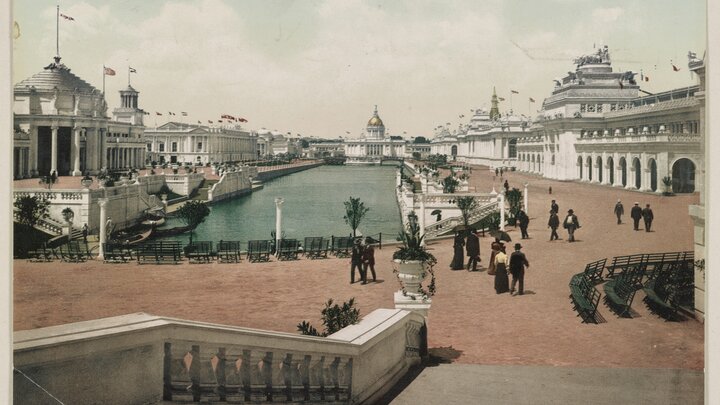
Lincoln, Neb.--“Exposition Exhibition: Art and the 1898 Omaha World’s Fair” will be on display in the MEDICI Gallery in Richards Hall Dec. 15-19.
The exhibition, created by students in Professor of Art History Wendy Katz’s 19th century American Art class revises, revisits and reimagines the Trans-Mississippi Exhibition.
The 1898 International Exposition in Omaha drew more than 2.5 million people, including President William McKinley and members of 35 Native American tribes.
“I think students came into the class feeling like this was a pretty ’niche’ subject in art history, but they quickly grasped the ways in which the categories created for art and culture in the 1890s are still determining university, museum and market decisions today,” Katz said. “I was proud of the thoughtful way that they engaged with and tried to understand the people and artists of 1898, though their views were so different than theirs. Their artwork is based on their research into objects (photos, souvenirs, artworks, et al.) from the 1898 exposition, but it expresses their own understanding of why the exposition still matters.”
The exhibition is curated by graduate students Toni Parker, Kerry Eddy and Jalen DeCoteau. Graduate student Madeline Butkovich is designing the graphics. Sixteen undergraduates are contributing artworks, and the other 14 students are writing papers.
The exhibition showcases projects that explore concepts and ideas inspired by at least three specific objects or visual materials from Omaha’s Trans-Mississippi and International Exposition.
Eddy, a second-year graduate student in studio art (painting and drawing), said the exhibition will include a wide range of projects.
“We have an amazing, insightful group of students who have chosen intriguing exhibits of the Trans-Mississippi International Exposition that they have taken an in-depth look at. Each student who has chosen to create works to reflect their research findings has a unique perspective,” she said. “We have printmakers, ceramicists, sequential artists (comic books), painters, sculptors, digital artists/animators, and graphic designers. I am looking forward to seeing what everyone has created and reading some of the research papers.”
She said the exhibit will bring to light a little-known piece of Nebraska history through an in-depth examination of this important event.
“The Trans-Mississippi International Exposition was a huge happening in the late 19th century,” Eddy said. “Though nothing of the buildings or most of the original exhibit remains, visiting our little exhibition will be an enlightening view into how events like the Trans-Mississippi expo shaped Nebraska and the Omaha area, in particular.”
Eddy will also be contributing a video on technology in which she reimagines several exhibits of the Trans-Mississippi Exposition in the context of a 21st century exposition.
“Using the lens of war propaganda, I have created 2D, digitally animated satirical pieces that address current political and social issues,” she said. “Exploring the subject deeply has shed a different light on the sociopolitical climate of the late 1800s.”
Ellie Nelson, a junior art history and studio art major, is creating dioramas of the Fine Arts Building and the Liberal Arts Building to include what was in each of them.
“In the real Fine Arts Building, it housed paintings, sculptures and ‘high art’ meant to demonstrate refinement, beauty and professionalism. It reflected aesthetic and moral progress,” Nelson said. “The real Liberal Arts Building contained objects related to education, science, technology and the applied arts, like photography, printing, pottery, typewriters, design and industry. It reflected intellectual and industrial progress and how innovation could improve society.”
Nelson said she found it interesting how the fair defined “art” and “culture’ into two different categories—industrial innovation and aesthetic refinement.
“I wanted to look more closely at those distinctions,” she said. “What I hope people get from the dioramas is an understanding of how the 1898 Omaha Exposition used art and architecture to define progress in two competing ways, one rooted in beauty and culture through the Fine Arts Building, and the other in productivity and modernity through the Liberal Arts Building, both reinforcing America’s vision of itself as a civilized, advancing nation.”
Amy Xu, a senior art major from Omaha, Nebraska, is contributing an artist book on Asian art. The class visited the UNL Libraries Special Collections, where they viewed artifacts from the fair.
“One of the pieces that caught my eye was a souvenir accordion book containing lithography prints of the buildings in the Exposition,” she said. “I loved the concept of a takeaway book and within my own art practice am very invested in artist books. A unique aspect of this class is the ability to create an artwork for our final project so inspired by a real souvenir from the fair. I wanted my content to be presented in an accordion book.”
While learning about the Exposition Xu saw a “Lipton Tea” banner above a pagoda.
“Lipton is an English company, so I wanted to explore the usage of Asian aesthetics and ‘exoticism’ to appeal to American audiences,” she said. “Through my research, the most surprising aspect was the connection of women and domestic life. How tea houses became one of the first places for women and a social space for them to belong.”
Xu said she thought a World’s Fair was about new inventions and had no idea there were also reenactments.
“At an exhibit called ‘Moorish Palace,’ there were many reenactments from a detailed labyrinth and Biblical scenes to a fake execution of Marie Antoinette,” Xu said. “This blended emphasis of the past while looking to the future was a fascinating and unexpected combination. While exhibits were meant to be realistic and informative, it also ended up as misinformation, and racist ideals being presented.”
Claudia Villegas, a senior art major from Omaha, Nebraska, is creating a two-sided coin. One side will be hand-beaded, and the other side will have watercolor.
“Two-sided coins were something that were often seen during the exhibitions during this time period, and they really caught my attention,” she said. “I think it’s interesting to create meaningful art for both sides of a coin, even if some people won’t look at it as much as others would.”
Villegas said the whole idea for her project revolves around Native American culture during this time and what that looked like to non-native people.
“Beading is a big part of Native American culture, so I really wanted to incorporate that,” she said. “My mother had been making beaded earrings for a long time as well, so I thought this would be a good opportunity to learn from her and spend time together. The backside will be watercolor. I’ll take a watercolor-safe paper that I painted a design on and put that on the backside of the beaded side.”
Anabella Kerans, a senior art history and psychology major, is contributing a research paper on the development of Kountze Place in North Omaha.
“Herman Kountze was a wealthy landowner, and he wanted nothing more than to make it a lavish neighborhood targeted to the upper class,” she said. “This particular plot of land became incredibly successful—with hosting the Omaha Exposition, the Greater Omaha Exposition, and eventually becoming the home of Kountze Place. My research covers how the luxurious Kountze Place neighborhood experienced white flight, redlining and heightened crime rates, all due to being the initial choice of the Omaha Trans-Mississippi Exposition.”
Kerans found learning about the Trans-Mississippi Exposition to be intriguing.
“I came into this class with almost no knowledge of the Trans-Mississippi Exposition, but through the process of the class, I feel that I have learned more than I ever thought I would. Having come from Omaha, I feel as if I have uncovered a hidden aspect of my home,” she said. “The exhibition will be an incredible learning opportunity for all those who choose to visit.”
Nelson said visitors to the exhibit should expect to see a wide variety of projects using different materials and showing different aspects and concepts surrounding the exposition.
“I want them to see the importance of the fair beyond the superficial white buildings and lights, and to understand how it represented or failed to represent certain groups of people, the political messaging that wasn’t obvious at first, and how it compared to other world’s fairs,” she said. “Before this class, I had no idea Nebraska held a world’s fair, and it would be a great opportunity for people to learn something new about our state and to show support for all the hard work that my peers and I have done over the course of this semester.”
Xu encourages people to come to the exhibit to learn about the Trans-Mississippi Exhibition and see the pieces students chose to focus on and study.
“There are so many interesting aspects to the exposition many of us learned and researched in the class, so the MEDICI Gallery exhibit will be a great way to learn about it in a fun and dynamic way,” she said.
In examining the legacy of the exposition, Nelson said the fair’s impact is still felt today.
“The Trans-Mississippi Exposition presented an image of progress through grand architecture, art displays, and technological demonstrations; however, it also relied on deeply problematic representations of Indigenous peoples and Black people,” she said. “It remains relevant today because many of the issues it raises, such as the erasure and romanticization of Indigenous cultures and the treatment of certain groups as ‘other,’ are still present in contemporary society. Studying the fair encourages us to look more critically at historical events like world’s fairs and to recognize both the beneficial and harmful impacts they have had.”
Nelson said this experience has reshaped the way she thinks about the past and its influence on the present.
“What I’ve gained from this experience is a deeper understanding of how historical events shape the way we view culture, identity and representation today,” she said. “It has also encouraged me to approach historical and cultural materials with more critical thinking, as well as a more informed and empathetic perspective.”