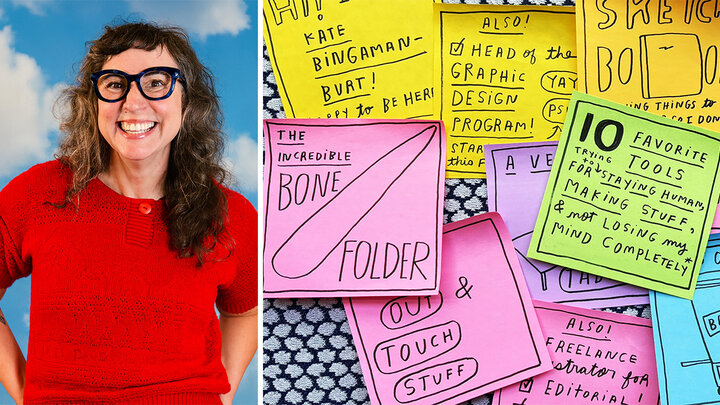
Lincoln, Neb.—Six artists will be presenting Hixson-Lied Visiting Artist & Scholar lectures this spring in the University of Nebraska–Lincoln’s School of Art, Art History & Design. The series begins with graphic designer and illustrator Kate Bingaman-Burt on Thursday, Feb. 5.
Each lecture will take place at 5:30 p.m. in Sheldon Art Museum’s Ethel S. Abbott Auditorium. The lectures are free and open to the public.
Her lecture will be titled “10 Tools for Staying Human, Making Stuff and Not Losing My (Your) (Our) Mind Completely.”
“It’s a collection of some of my favorite creative tools and ideas I’ve leaned on over the years to stay grounded, curious and connected to myself and others,” Bingaman-Burt said. “The talk is deeply analog and a big, joyful pushback to the always-on digital landscape. I’ll be sharing personal stories, ongoing drawing rituals, community printing projects, and lots of talk about pens, zines and process. If you like printing, daily practice or creative survival tactics, this one’s for you.”
Bingaman-Burt (UNL M.F.A. 2004) is an illustrator, educator and community builder based in Portland, Oregon. She is professor and head of graphic design at Portland State University’s School of Art + Design, where she has taught since 2008.
“We’re known for our big, community-facing events like Be Honest (an open-to-all design party that brings together students from every level of the program with Portland’s design community), Good Market (a student-run design market) and Fresh (our twice-a-year senior portfolio show). I also help run our in-house client studio, Rodeo, which gives students hands-on experience working with real clients on real deadlines,” she said.
In 2017 she founded Outlet, a risograph print studio, zine library and workshop space that celebrates creative publishing and hands-on making.
“Since 2022, I’ve been proud to call Leland Vaughan my official partner in the space,” she said. “We co-run Outlet together and have built it into something that reflects both of our creative values and community roots. Outlet is very much an extension of the way I teach and live. It’s all about access, experimentation, community and creative permission. It’s not about perfection. It’s about making something together.”
Bingaman-Burt’s running “Daily Purchase Drawing” project, which began in 2006, documents the things she buys through hand-drawn receipts and objects. This daily practice has grown into exhibitions, books and an ever-expanding archive of illustrated life. Her work explores themes of observation, routine, and connection—using drawing as a way to slow down, pay attention, and share stories.
“I’ll be celebrating 20 years of this project while visiting Nebraska,” she said. “On Feb. 5, 2006, I started drawing one thing I purchased every day, and this project has morphed into published books, zines, prints and is really the foundation for how I work.”
It began as a spin-off to an earlier piece in which she hand-drew all of her credit card statements as a form of process.
“But I accidentally tricked myself into loving the process,” she said. “I still wanted to draw, just not my statements anymore, so I shifted to objects—one purchase a day. At first, it was about documenting and gaining confidence with drawing. But now, nearly two decades later, it’s more about ritual and storytelling.”
She said the practice has taught her about discipline, imperfection and observation.
“I don’t remember most of what I’ve drawn, and that’s kind of the point,” she said. “It’s not just about the object—it’s about the showing up. The act of drawing every day has anchored me through different jobs, cities, projects and life phases. It’s like time travel, therapy and mark-making all rolled into one.”
The project continues to evolve and keeps her curious.
“The roots of this project were planted at UNL during my Obsessive Consumption days when I was photo-documenting everything I bought with a 2.1 megapixel camera and building a website and online shop around it,” she said. “That framework—the daily practice, the obsessive cataloging, the playful transparency—has stayed with me ever since."
Bingaman-Burt is looking forward to returning to the University of Nebraska–Lincoln for the lecture.
“Grad school at UNL meant everything to me, and I’m constantly amazed at how much it shaped the way I move through the world,” she said. “It’s where I learned how to teach, to collaborate, how to show up, and how to build a framework for a sustainable creative life.”
It’s also where she learned that her peers are her greatest teachers.
“The people who showed up, stayed late and worked hard alongside me were where the magic was,” Bingaman-Burt said. “I was the only graphic design grad student at the time, so I found my people in printmaking and ceramics. They became my collaborators, critics, cheerleaders and lifelong friends. Jenni Friedman, Kristen Martincic, Deb Oden, Kathy Puzey, Ian Anderson, Brian Curling, Kyle Olson, Richard Schwartz, Kari Radash, just to name a few, were and still are my people. I just texted my group thread with Deb, Jenni and Kristen this morning, and Jenni is flying in to stay with me during this visit. That says it all. Grad school was one of the best jobs I’ve ever had.”
She appreciated how open-ended the curriculum was.
“It was ideal for self-starters,” she said. “I had a lot of freedom, and I used it to deep dive into process and community. Ron Bartels was my faculty advisor, and he just let me run with things, which I deeply appreciated. The real learning happened in those late nights in the Woods studio, where everyone helped each other out. It was very much a ‘rising tide lifts all ships’ environment. That’s where I first understood how to teach and lead through support, generosity and example. And the mix of hard work and celebration was unmatched. A perfect night was working in the studio for hours and then heading to Duffy’s for a cheap beer and a truly excellent indie-rock show. Hello, early 2000s Omaha/Lincoln booming music scene. Not to be a supreme dork, but it was the Good Life.”
Her advice to students is to make work that feels like you.
“Not the version of you that you think you should be, but the weird, curious, excited version,” Bingaman-Burt said. “The version that collects things, obsesses over fonts, rewatches old TV shows and notices packaging at the grocery store. Also, share your work. Share your process. Share even when it’s not perfect. The world isn’t waiting for your masterpiece—it just wants to connect with something real.”
In addition to her personal projects, she collaborates with clients such as The New York Times, Airbnb and the Oregon Museum of Science and Industry. She also lectures widely about sustaining creative practice, teaching, and building joyful, community-centered spaces for art and design.
The remaining lectures in the series are:
• Feb. 18: Barbara Bosworth. Bosworth is a photographer whose large-format images explore both overt and subtle relationships between humans and the natural world. Her caring attention results in images that remind viewers not only that we shape nature, but that it also shapes us.
• March 26: Binh Danh. Danh reimagines traditional photographic techniques to explore history, identity and place. Known for his contemporary daguerreotypes of National Parks, his reflective images invite viewers to see themselves within the American landscape. He is an associate professor of art at San José State University.
• April 9: Kevin Colls. Colls is a professional archaeologist and reader of archaeology working for the Centre of Archaeology based at the University of Huddersfield in the United Kingdom. For 24 years, he has directed and published archaeological projects throughout the United Kingdom and Europe and has widely travelled to sites across the world.
• April 16: Annette Becker. Becker is an arts educator and scholar whose research focuses on fashion history. She serves as the curator and director of the Texas Fashion Collection, an academic fashion archive at the University of North Texas.
• April 30: Sara Jimenez. Jimenez’s work materializes invisible histories and a kaleidoscopic connectedness she has to her ancestors and their land. She works in installation, sculpture, collage, and performance to create visual metaphors through fantastical environments and otherworldly, biomorphic objects. Most of her research and inspiration comes from learning about the landscape and narratives from her genealogical roots in Southeast Asia, the Pacific, and the ancient U.K.
The School of Art, Art History & Design’s Hixson-Lied Visiting Artist & Scholar Lecture Series brings notable artists, scholars and designers to Nebraska each semester to enhance the education of students. The series is presented in collaboration with Sheldon Museum of Art.
Underwritten by the Hixson-Lied Endowment with additional support from other sources, the series enriches the culture of the state by providing a way for Nebraskans to interact with luminaries in the fields of art, art history and design. Each visiting artist or scholar spends one to three days on campus to meet with classes, participate in critiques and give demonstrations.
For more information on the series, contact the School of Art, Art History & Design at (402) 472-5522 or e-mail schoolaahd@unl.edu.