Lincoln, Neb.--The School of Art, Art History & Design will host seven MFA Thesis Exhibitions from March 9 through April 10 in the Eisentrager-Howard Gallery in Richards Hall.
The exhibitions will take place during the following three weeks:
• March 9-13: MFA Thesis Exhibition I: Brian Garbrecht and Rachel Clarke. A closing reception will be held on Friday, March 13 from 5-7 p.m. in the gallery. An artist talk will take place on Friday, March 13 at 4 p.m. in Richards Hall Rm. 15.
• March 23-27: MFA Thesis Exhibition II: Allie Wheeler, Ani Sargsyan and Daniel Garcia. A closing reception will be held on Friday, March 27 from 5-7 p.m. in the gallery. An artist talk will take place on Friday, March 27 at 4 p.m. in Richards Hall Rm. 15.
• April 6-10: MFA Thesis Exhibition III: Emmanual Asamoah and Joshua Goering. A closing reception will be held on Friday, April 10 from 5-7 p.m. in the gallery. An artist talk will take place on Friday, April 10 at 4 p.m. in Richards Hall Rm. 15.
The Eisentrager-Howard Gallery is located on the first floor of Richards Hall on the university’s city campus at Stadium Drive and T streets. Gallery hours are Monday-Thursday, noon to 5 p.m. Admission to the gallery is free and open to the public.
For more information on these exhibitions, please contact the School of Art, Art History & Design at (402) 472-5522 or e-mail schoolaahd@unl.edu. Follow the gallery on social media via Instagram (@eisentragerhoward) and Facebook (@EHArtGallery) to be informed of any gallery updates.
More information on each artist and exhibition is below:
• Brian Garbrecht: “Part of the Family”
“Part of the Family” explores how television becomes kin—an adopted presence that organizes domestic life, shapes memory and quietly disciplines attention. Growing up in the 1990s, the TV structured his family’s routines, furniture and emotional rhythms. Much of his family time happened in front of a screen. Garbrecht reconstructs that environment to examine how intimacy is produced through repetition and how persuasion enters the home disguised as entertainment.
Garbrecht is a multidisciplinary artist from Elgin, Illinois, pursuing his Master of Fine Arts in Studio Art with an emphasis in photography. In 2022, he received his Bachelor of Fine Arts degree from Northeastern Illinois University. His work combines photography, video, family archives, appropriated media and installation to explore how archives, television and memory shape personal and collective identity. He is the recipient of the 2024 Howard Creative Achievement Award and the 2025 Cather Graduate Excellence Award from UNL. His work has been exhibited nationally and internationally and has received recognition from the Society for Photographic Education, Duke University’s Center for Documentary Studies and Hilarity for Charity.
• Rachel Clarke: “The Space Between Seams”
Through the use of form, softly muted colors, and play with transparent materials, Clarke creates ethereal drawings and immersive installation experiences. She works with the softness in fabric and the controlled detail in drawing. In doing so, she is enveloping herself in the drive to create, pushing the viewer to be spatially aware of their bodies existing in space. “The Space Between Seams” exists as she is processing the state of her own body. The fabric panels she creates call to the porosity and permeability of human skin. The skin is a container of our organs, yet it is an organ itself, filtering the external materials from the rest of our body. The installation is reminiscent of a body or organism, with a distinct exterior to observe and an interior to be surrounded.
Clarke is an interdisciplinary artist working with methods of painting, drawing, photography and textiles to create immersive installations. Originally from Cedar Rapids, Iowa, she discovered a love for craft and arts from a young age. She received a Bachelor of Fine Arts degree with an emphasis in drawing from the University of Northern Iowa. She is currently working towards a Master of Fine Arts degree with an emphasis in painting and sculpture from the University of Nebraska-Lincoln. Clarke’s work has been exhibited regionally in the United States.
• Allie Wheeler: “Sweet is the Work”
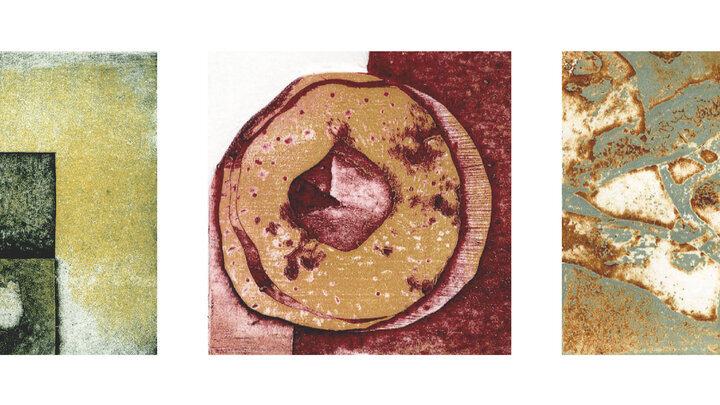
“Sweet is the Work” is a collection of collagraph prints, collages and sculptural artworks created through a dialogue of shared surface textures, colors and imagery specific to Wheeler’s personal experience. This body of work represented themes of childhood, memory, labor, farm life, place, religion, heritage and familial relationships. Together, these themes support an all-encompassing investigation of the meaning of home. Home is considered from inside and beyond, through a personal connection to the domestic interior and agricultural landscape shaped by care, labor and experiences. Her work functions as a visual journal, a self-developed process of documentation inspired by a history of family record keeping.
Born in Delta, Utah, Wheeler is a mixed-media artist working primarily in printmaking. She received her Associates of Fine Arts from Snow College and her Bachelor of Fine Arts in 2-dimensional art from Weber State University. Her work has been shown in various exhibitions. Her work serves as a documentation of experiences and influences that have shaped her understanding and connection to home through labor and memory. Using processes of print, collage and sculpture, her history becomes embedded into each layer of the piece.
• Ani Sargsyan: “Sparks Under Ashes”
Sargsyan’s body of work incorporates painting, drawing and transfer processes to uncover themes of distance, memory and fragility while celebrating Armenian identity through confrontationally hopeful and reflective outlooks. The Armenian genocide of 1915 fragmented culture and created distance between Armenians and their lands. This fragile quality emerges in her work through the transfer process as it scars elements with tears, holes and rips. With over a century having passed since these horrors, no more witnesses are among us. Only echoes and whispers remain to shape the Armenian collective memory. Thus, her work is guided by a soft color palette and ghostly figures to reference the remnants of these quiet memories.
Sargsyan was born in Vanadzor, Armenia, and spent the early years of her life in the United States. She received her Bachelor of Art in art from Luther College in Decorah, Iowa, and a minor in museum studies. She is currently working towards her MFA degree in painting and drawing at the University of Nebraska-Lincoln. Sargsyan’s works have been exhibited regionally both in the United States and Armenia. Using acrylics and transfer processes, she uncovers Armenia’s rich history and culture by referencing the symbolism and motifs of ancient Armenian manuscripts. By merging these elements with personal experiences and observations from the ongoing conflict in the region, her compositions bring to light the encounters of contemporary Armenian life.
• Daniel Garcia: “Subterranean Echoes”
Garcia uses clay and glaze to create tangible visionary works that make his dreams and inner truths visibly sensible in the external world. When working with clay, he channels energy through a primordial process involving earth, water, air and fire that connects him to the divine and his ancestors. Through his work, he explores the soul, spirituality and finding divinity within the geological world.
Garcia is a visionary artist working in clay and ceramic materials. He was born in the northwest region of the Mojave Desert in Lancaster, California, where he began his studies in the ceramic arts. In 2021, he completed his undergraduate degree at California State University, Long Beach, receiving a Bachelor of Fine Arts in ceramics. He is currently working towards an MFA degree in ceramics at the University of Nebraska-Lincoln. Garcia’s works have been exhibited regionally in the United States. His works represent ancestral beginnings that weave spiritual connections to contemporary life through an animistic lens.
• Emmanuel “KStony” Asamoah: “(Arrival is Not Access)”
Asamoah works with clay, metal and found objects because they carry history. These materials hold traces of labor, movement and everyday life, and he uses them to tell stories about memory, identity, and change. He first learned clay in Bekwai, Ghana, from his grandmother, who made pots and grinding bowls for daily use. Watching her work taught him that ordinary objects can hold deep meaning. That early experience still shapes his practice. Today, he combines traditional ceramic methods with metal and reclaimed materials to reflect both where he comes from and where he is now. His work focuses on breaking, rebuilding and reusing materials as a way to think about migration, cultural memory, Life and resilience. He sees repair not as fixing something back to what it was, but as a way to create something new. Through sculpture and installation, he explores how social, cultural, and economic systems affect our lives, while giving space to stories that are often overlooked.
Asamoah received a Bachelor of Arts in industrial art (ceramics) from Kwame Nkrumah University of Science and Technology in Ghana and is currently pursuing an MFA in studio art at the University of Nebraska–Lincoln. In 2024, he received the NCECA Multicultural Fellowship, recognizing his growing presence in contemporary ceramics. His work has been exhibited in the U.S. and Ghana. Working with clay, metal, and found materials, Kstony explores how stories of breakage, repair, and continuity move across cultures, connecting his Ghanaian roots to a broader contemporary context.
• Joshua Goering: “From the Pit”
Clay retains histories. It holds a memory of each action experienced on its surface and in its form. Goering is a potter focused on making objects that capture these moments. He pinches, scrapes, trims, throws and carves, exposing tooth and excavating form. Working with local material guides the ethos behind the work, grounding him in place and connecting him to the environment. The form language curated is, in part, inspired by his process and tools. These utilitarian objects interest him; their qualities vary according to the tasks they are afforded in a manner similar to functional pots. Using their profiles in his dialect as symbol can lead to a deeper understanding of the object's material history. Goering mines ceramic history, seeking to contextualize these symbolic objects and study what came before. He selects from across different periods and regions, chasing what resonates with place, symbol and process. He is interested in disparate objects having connections to one another, visible or invisible.
Goering was born and raised in Kansas City, Kansas. In 2021, he graduated from the University of Kansas with a B.F.A. in ceramics and a B.A. in environmental studies. Following this, he did a year-long internship at Starworks Ceramics. Goering’s work hinges on his environmental disposition, an inquisitive nature surrounding materials and an inherent love of process. His current work involves a dialogue with the regional landscape using local clays and rocks, as well as hand-building forms that reference objects involved in his process.