Lincoln, Neb.--For a designer who has helped build cinematic worlds for some of Hollywood’s biggest films, receiving recognition from the place where it all began carries special meaning for Tim Croshaw (B.F.A. 2000).
“It was incredibly meaningful. I’m very appreciative of the honor from the university,” said Croshaw, who is one of nine alumni named to the 2026 class of Alumni Masters by the Nebraska Alumni Association. “I’m a proud UNL graduate and an Omaha native, so being recognized by the place where my journey really began means a great deal to me.”
Croshaw will be on campus April 8-10 to interact with students and faculty in the Johnny Carson School of Theatre and Film.
Raised in North Omaha’s Florence neighborhood, Croshaw grew up in a close-knit community where family and school played a major role in shaping his future. He credits his time at McMillan Middle School and Omaha North High School with giving him confidence and a sense of possibility early in life.
“I cannot explain how much these two schools changed my life and equipped me with a sense of who I could be,” he said. “They gave me knowledge and tools that would elevate me beyond other students.”
Choosing the University of Nebraska–Lincoln for college felt natural for Croshaw and allowed him to remain connected to Nebraska while exploring his creative interests. At first, though, he was unsure of which path to follow. He entered UNL considering an English major and focusing on creative writing, but he was also interested in pursuing scene design in theatre.
Like many aspiring artists, he wrestled with doubts about his abilities.
“I struggled with something that many young artists experience—the belief that I couldn’t draw and that somehow meant I couldn’t be a designer,” he said.
At UNL, he discovered that design involved far more than just drawing.
“What I learned was that design is about storytelling, collaboration and problem-solving,” Croshaw said. “Once I understood that, I gained confidence in myself that pushed me forward, even to this day.”
During his time in the theatre program, he gained hands-on experience working on numerous productions in the Temple Building and at the Lied Center for Performing Arts. Faculty members and staff played a crucial role in shaping his development.
He recalls professors Ed Stauffer, Chuck O’Connor, Laurel Shoemaker and Janice Stauffer as particularly influential mentors, along with staff members like Brad Buffum, who helped guide him through the production process.
“They gave us everything they had,” he said. “They were incredibly generous with their time and knowledge.”
Working alongside graduate students and faculty, undergraduates participated in dozens of productions and even toured with some shows—experiences that provided practical training and prepared him for graduate school.
“That kind of hands-on experience gave me an immense amount of practical knowledge and ultimately put me ahead of many of my peers when I entered my Master’s program,” he said.
Another formative outlet was Theatrix, the student-run theatre organization that allows students to experiment and take creative risks.
“It felt like a real consortium of student artists experimenting and pushing boundaries,” he said.
One project, in particular, stands out in his memory.
“A group of us created a movement piece with actors, loud music and a surprising amount of production value considering the budget,” he said. “We were experimenting with staging and even placed lights in the audience to create a more immersive experience. Looking back, we probably broke a few rules along the way, but at that stage of our lives we were very much in the ‘ask forgiveness rather than permission’ phase of being young artists. That spirit of experimentation was a huge part of what made the program so exciting.”
Those experiences helped solidify his interest in design and storytelling. While many designers cite blockbuster films such as “Star Wars” and “Blade Runner” as inspiration, Croshaw points to the independent film movement of the 1990s as a turning point for him.
Directors such as Quentin Tarantino, Kevin Smith, Robert Rodriguez and the Coen Brothers demonstrated that visual style and storytelling could emerge from bold, personal creative choices.
“Those movies made me realize that filmmaking wasn’t just spectacle—it was storytelling through visual choices,” he said.
Set design, he realized, is one of the ways those choices become physical.
“You’re building worlds that actors can inhabit and that audiences can believe,” he said. “It combines art, engineering, storytelling and collaboration.”
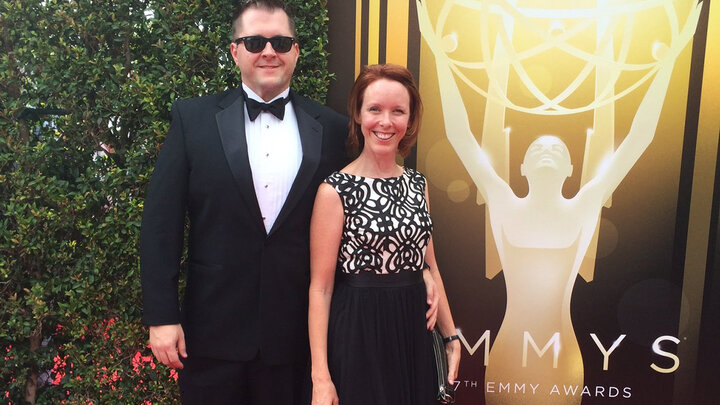
After graduating from UNL, moving to Hollywood was not immediately on his mind. Instead, he continued his education, pursuing a master’s degree in design at Florida State University. There he met his future wife, Shanna Starzyk, an Emmy-nominated art director.
The couple spent summers working at summer stock theatres such as the Utah Shakespeare Festival and Williamstown Theatre Festival while deciding where their careers might take them.
“We weren’t entirely sure where we would land,” he said. “It could have been New York, Chicago or Los Angeles.”
Eventually they chose Los Angeles—partly for the sunshine—and packed a U-Haul for the cross-country drive.
Breaking into the film industry required persistence. When they arrived in California, they stayed with a fellow UNL theatre alumnus, Dawn Schaffer and her husband Gary, while searching for work and housing. Using a directory of members from the Art Directors Guild, they began cold-calling professionals in the industry from their apartment, sometimes retreating into the bathroom to escape construction noise while making calls.
The strategy paid off.
Through a series of introductions, he eventually landed a production assistant job on the television series “Medium.” Working closely with production designer Jessica Kender and art director Kathleen Widowski, he proved himself through hard work and was promoted to set designer the following season.
More than two decades later, he still credits those early mentors for helping launch his career.
“I owe a great deal of my career to the mentorship and support of some very strong women along the way,” he said.
Since then, he has worked on numerous major film productions, creating environments that help directors bring stories to life. One especially meaningful moment came when he helped design the Fortress of Solitude for a recent Superman film.
As a child, Superman had been his favorite comic book hero.
“When I was about three or four years old, I had Superman Underoos,” he said. “At family gatherings I would jump off the coffee table pretending to fly.”
Decades later, he found himself helping design one of the character’s most iconic locations.
“Cut to some 40 years later, and I am designing the Fortress of Solitude for ‘Superman’ working with Production Designer Beth Mickle to develop that world, the technology and the giant sun device. That was incredibly cool,” he said.
Despite the scale of modern film productions, his approach remains rooted in the fundamentals he learned as a student.
“My job is to understand the script and the intentions of the production designer and director,” he said. “From there, I adapt my approach to support that vision. My biggest strength is adaptability. I can reshape my process depending on the project.”
Research and observation play a major role in his creative process, and he emphasizes that an artist’s personal experiences shape the work in ways technology cannot replicate.
“Technology helps a lot today, but inspiration also comes from simply observing the world from my perspective,” he said. “My life and my experience shape my art, and that is something that is completely unique and human. That is something technology can never replace.”
For students interested in set design, he encourages starting with theatre because it’s the great collaborative medium.
“In theatre you learn composition, color theory, lighting and staging—everything you need to design worlds and understand how visual environments support storytelling,” he said.
Technical tools, such as 3D modeling software, can come later.
“Knowing software can make you a great technician,” he said. “But having a point of view—and understanding how to reinforce the script and the scene to support the performance is what makes you an artist.”
He also reminds aspiring designers to think practically.
“A set might look beautiful,” he said, “But if you can’t fit a camera crew inside it, it doesn’t work.”
Technology has evolved dramatically since his student days. Early design programs had limited capabilities, and digital tools were far less powerful. Today he builds fully textured, detailed 3D environments that convey mood and atmosphere.
Yet the core principles remain unchanged.
“Technology is simply a tool for expression,” he said. “Use it—but also understand the fundamentals of drawing and design. Carry a sketchbook. Keep creating personal work even after you’re established to showcase who you are and what your perspective is.”
Croshaw recently completed work on the upcoming film “Jumanji 3,” which involved building large-scale sets and filmed in Los Angeles and Hawaii, that will be out in December. He also collaborated on a project titled “The Further Adventures of Cliff Booth,” directed by David Fincher and written by Quentin Tarantino, set in 1970s Los Angeles.
Even after years in the industry, he continues to challenge himself creatively and remains committed to supporting the next generation of designers. In addition to his professional work, he teaches at the American Film Institute and serves in leadership roles with the International Alliance of Theatrical Stage Employees (IATSE Local 800), advocating for careers in the industry.
Looking back, he attributes his success not to luck but to perseverance.
“Some people say they were simply lucky to get where they are. While I understand that sentiment, I don’t fully believe in it,” he said. “I worked extremely hard to build my career, and I did it intentionally. There were late nights, difficult moments and many people who pushed me forward—some with encouragement, others with skepticism. I’m grateful for all of them.”
As he prepares to return to UNL as an Alumni Master, he hopes to share that message with students. For him, the arts remain essential to human life—an idea he believes deserves constant defense and celebration.
“Art does not exist without an audience. That audience may be one person or millions of viewers,” he said. “Pop culture is sometimes treated as a lesser form of art, but the truth is that people crave creativity in their lives whether they recognize it or not. Art has been part of our humanity since the earliest cave paintings. Today it continues through theater, film, music, architecture and the stories we stream into our homes every day. It can be dismissed as simple, but it’s invaluable because not everyone can do it.”
He says we are drawn to stories on screen or on the stage because we see reflections of ourselves in them.
“Our fears, our hopes, our horrors and our ambitions,” he said. “Stories allow us to imagine lives beyond our own. That is the power of arts. It can transport us, connect us and reminds us of our shared humanity. For that reason, the creation of art is not a luxury. It is a necessity. And it is something we must never surrender being its creator or abstain from its pursuit.”
And for students pursuing creative careers, he offers a simple encouragement to keep making things.
“What is the saying? Day by day we get better and better,” he said.
Alumni Masters is a program sponsored by the Nebraska Alumni Association, the Student Alumni Association and the UNL Chancellor’s Office. Outstanding alumni return to campus to share their experiences and knowledge with students. Since 1964 more than 400 alumni have participated in Alumni Masters. Read more about the program at https://go.unl.edu/2026alumnimasters.