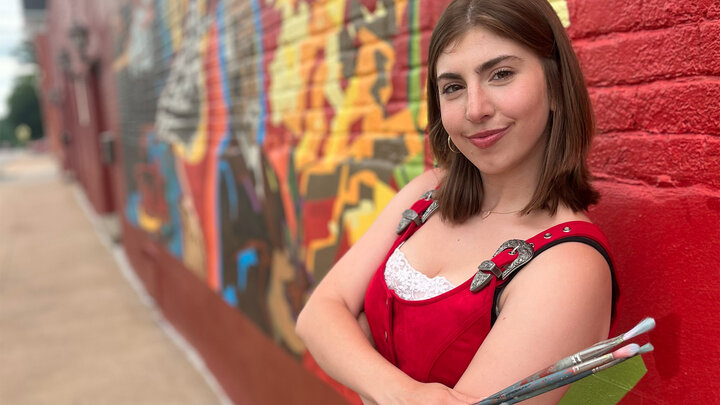
Lincoln, Neb.--For senior art major Katie Dia, creating a mural in Nebraska City this summer was more than an opportunity to add a splash of color to her hometown’s Main Street. It was a chance to give back to a community that helped shape her as an artist.
Dia designed and led the creation of “A Commemoration to America 250th: Nebraska City,” a large-scale public mural celebrating Nebraska City’s history as part of the community’s America 250 commemorations. The mural is located on the west side of the building at 1024 Central Ave.
The project, completed in June, brought together Dia’s interests in painting, public art and community collaboration. The brightly colored, abstract mural moves chronologically through Nebraska City’s history, incorporating imagery connected to the community and the state, including references to Lewis and Clark, Arbor Day, Arbor Lodge, windmills and Nebraska’s state symbols.
For Dia, the project began with an idea — and the confidence to bring it to the people who could help make it happen.
“This project was an idea I had that happened to come true,” Dia said. “Growing up in Nebraska City, I built a reputation for having big art ideas. My mom, who is a very talented mural artist and teacher, always showed me the value of arts in the community. Luckily, I have people in the community that support my crazy ideas.”
Dia, who grew up originally in Cave Creek, Arizona, moved to Nebraska with her family when she was 10. She has family in Nebraska City and considers the community home.
Last November, she approached Tammy Partsch, who leads Nebraska City’s America 250 committee, with an idea for a colorful public mural that would commemorate the city’s history while inviting the community to participate in its creation.
“I wanted to make the project a community initiative that allows anyone to be involved with the process of making the mural,” Dia said. “The most important aspect of public space murals is not only allowing access for anyone to view art but for those who come by it to be inspired to want to create.”
The project quickly grew beyond the original concept.
Dia created a rough sketch, developed a budget and outlined plans for mural workshops. With Partsch’s help refining the proposal, the America 250 committee approved and funded the project and identified a building on Main Street as its home.
But approval was only the beginning.
Dia continued researching Nebraska City’s history, revising the design and coordinating the practical details necessary to complete a large public artwork. The design underwent multiple revisions as additional elements were suggested, including references to the city’s windmills and Arbor Lodge.
“When creating any public space mural, it’s my job as an artist to be diligent in researching the space that the art is occupying,” Dia said. “In this case Nebraska City’s history.”
The mural ultimately became what Dia describes as a “historic flow map” of Nebraska City.
“The concept of the mural was a historic flow map of Nebraska City’s history,” she said. “The image flows from left to right chronologically. I used iconography from Nebraska’s state symbols such as the state bird, and flower as well. I wanted the image to be more abstracted and bright.”
The emphasis on brightness was intentional. While Nebraska City already has several public murals, Dia wanted her contribution to bring a more contemporary visual energy to the city.
“Nebraska City has quite a few murals, but most of them aren’t very vibrant so I wanted this one to stand out,” she said.
The mural’s message also connects the local project to the larger occasion of the nation’s 250th anniversary.
“I was interested in using the opportunity of the occasion of America’s 250th anniversary as a means of thinking about what makes America so special to me,” Dia said. “For me, patriotism is about the unity. I think that so much of this country is built on people who have come from all over and have worked together to create what we have today.”
That spirit of unity shaped not only the mural’s imagery but also the way it was created.
Before painting began, Dia conducted a mural workshop with students at Lourdes Central Catholic School and recruited high school students and community members to participate. She also assembled a team that included School of Art, Art History & Design alumna Amy Xu (B.F.A. 2026) and fellow senior art major Jackie Hinzman as paid mural assistants.
In the end, the project brought together the two assistants, six high school students, Dia’s younger brother and four community volunteers.
“The imagery and message of the mural capitalizes on Nebraska City’s history, but the execution was done with collaboration with the community,” Dia said.
The experience gave Dia an opportunity to put lessons from her education at the University of Nebraska–Lincoln into practice on a scale far larger than a traditional studio project.
“Through my education at UNL I have not only fine-tuned my painting skills, but learned the importance of a good concept,” she said. “My professors have taught me to explore colors, concepts, and construction of the art I create. All those aspects helped me create the final image for the mural.”
Her previous experience in a mural class taught by Associate Professor of Art Sandra Williams also helped prepare her for the challenges of designing art for a public setting. In that class, students collaborated with local clients and learned about the process of creating murals in public spaces.
“Williams taught me the importance of transforming a space with imagery,” Dia said. “Through that class I learned that public space mural arts have a real value in providing an opportunity for anyone to view and interact with art in their space.”
Dia had previously been selected to create the design for a mural on the TMCO building in Lincoln, an experience that helped her understand both the possibilities and responsibilities of public art.
For the Nebraska City project, however, she took on an even broader role. In addition to designing the mural, she organized workshops, recruited volunteers, purchased supplies and secured city permits and insurance. All of it happened while she was balancing full-time studies and work.
“The hardest challenge when it came to time on this project was the ability to juggle full-time school and work on top of trying to make this project happen,” Dia said. “Often times as a student you learn to hustle to make everything happen.”
The work also required her to think differently about the audience for her art.
“The hardest part about placing imagery in a public sphere is creating something that provides inclusivity to the people who view it,” she said. “Public Space mural arts are unique in the fact that they are accessibly to truly anyone who encounters one.”
That accessibility was especially important to Dia, who wanted the project to encourage young people to see themselves as creators and participants in the arts.
“I have always found it important to give back to the communities that help support and shape me as a person,” Dia said. “This project was special to me because Nebraska City is a place I consider home.”
She added that the community’s response has been one of the project’s most meaningful outcomes.
“The support I have received after completing the mural has been incredible,” Dia said. “I think having people be so grateful to see art up in their city was something that I didn’t expect to the degree that I saw through this project.”
For Dia, the experience demonstrated that creating public art requires much more than painting.
“The most rewarding part of the mural was the learning process that happened along the way,” she said. “I think looking back on the project I learned so much from not only myself but from those in the community. Making a project like this happen really took a village.”
For Dia, the mural is a lasting reminder of the place she calls home.
“It means a lot knowing that I was able to provide something back in turn for all of the support and help I’ve received growing up from the amazing people who make Nebraska City special to me,” she said.