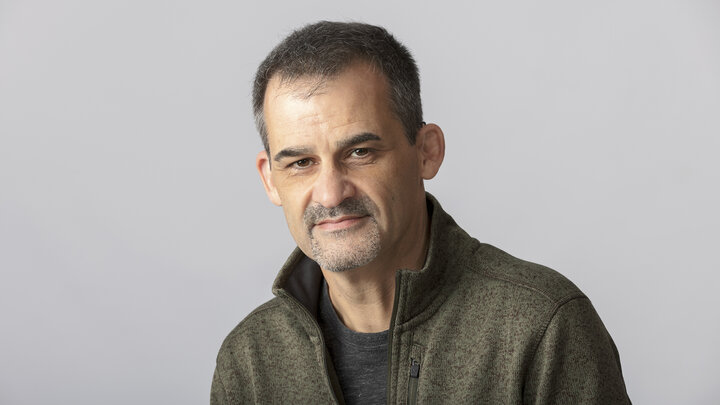
Lincoln, Neb.--For three days, Comet Smith had no music notation software, no phone and no Wi-Fi. Instead, he found himself in Denali National Park and Preserve, surrounded by mountains, wind, wildlife and something perhaps even more powerful for a composer—silence.
Smith, a senior music composition major in the Glenn Korff School of Music, was one of eight composers who participated last summer in Composing in the Wilderness, an immersive program that takes composers into Alaska’s Denali National Park to experience the landscape before creating new works inspired by it.
The experience challenged Smith to think differently about music, nature and the creative process and ultimately helped him better understand his own artistic voice.
“I think, kind of ironically, sound-wise, the lack of sound sometimes was the most exciting,” Smith said.
The opportunity first caught Smith’s attention as a member of the UNL Wind Ensemble, when he performed works written by composers who had previously participated in Composing in the Wilderness, including Glenn Korff School of Music alumnus Trevor Frost (DMA 2024).
“I think Trevor recommended I apply because I compose a lot of music about nature, and this is a very unique program when it comes to composition festivals and stuff,” Smith said.
Once Smith arrived in Alaska, however, the experience quickly became about much more than composing music about a beautiful place.
One of the first moments that made an impression was seeing Denali itself. Denali is the highest mountain peak in North America at 20,310 feet above sea level in the Alaska Range.
Smith and the other composers were riding a bus into the park, scanning the landscape and trying to identify the mountain among the peaks surrounding them. Program leader Stephen Lias told them they would know when they saw it.
“And then we turned a corner and we went, ‘There it is,’” Smith said. “Yeah, so that was pretty wild.”
Denali’s scale was difficult to comprehend — and even more difficult to translate into music. But Smith was equally fascinated by what wasn’t there.
The group worked with Halyn Betchkal, an audiologist from the National Park Service who records the sounds of Denali National Park, including its periods of relative silence. Smith learned that Denali is one of the few places in the United States where a person can go an entire day without hearing a combustion engine.
“It’s still kind of rare, because planes exist,” Smith said. “But that kind of silence and that maybe not silence because there's wind and grass and animals, but the complete lack of human intervention and human-made noises.”
For Smith, that absence of technology and human-made sound created an unusual freedom.
“We were advised to not bring our phones into the park,” Smith said. “And so just having those days away from technology in general, not having it in the back of your mind, was very enlightening, very freeing.”
The composers spent three days in the park before moving to the Denali Education Center, where they had access to electricity and Wi-Fi and just three days to turn their experiences into music.
Each composer was assigned to write a new work for the Corvus Ensemble, which would perform the pieces only days later.
Smith knew immediately that Denali would be at the center of his composition. The challenge was figuring out how to represent something so immense with only four musicians.
“I was struggling because I had a small ensemble of four players, and I had no idea how to depict such a huge thing,” Smith said. “I was, like, this needs to be, a full orchestra piece.”
The ensemble consisted of flute, saxophone/bass clarinet, cello, violin and percussion, with composers writing for subsets of four instruments. Smith chose flute, alto saxophone, violin and percussion, meaning there was no cello and no low-register instrument.
“My lowest note was like an F3, so that was another issue with trying to depict the mountain is that I only had soprano and alto instruments, so I really had to utilize them,” Smith said. “I had to play to their strengths. It changed how I was thinking about the piece and what emotions I could represent with that pitch range.”
Rather than trying to make the music as enormous as the mountain, Smith changed perspective.
The resulting piece became a lullaby — not one sung to the mountain, but one imagined from the mountain’s perspective.
“I ended up flipping it and focusing kind of on how small I felt compared to the mountain,” Smith said. “I ended up writing a piece that's kind of a lullaby from the mountain's perspective to us kind of looking down on us and our silly little problems and its infinite age and size.”
The demanding schedule left little room for hesitation. Smith had to keep moving forward, even when ideas did not work.
“I found I had to keep writing no matter what, even if I was deleting drafts or changing concepts,” Smith said.
The other composers provided another source of inspiration. Some worked in solitude, while others spent their time together in communal spaces, discussing what they were creating.
“Whether or not we were actually working together. Just being around so many creative people in such a beautiful space really helped inspire me to get working,” Smith said.
The experience also reinforced something Smith had begun to recognize about his own creative interests.
“It’s helped me figure out what I find important and how to communicate that through my music,” Smith said. “I think that kind of approach to writing and writing about the space we live in and the feelings that come with that is something that's very important to me.”
When the composers finished their pieces, the works moved quickly from the page to performance. The Corvus Ensemble rehearsed the music in Fairbanks before presenting concerts at the University of Alaska Fairbanks and the Denali Visitors Center.
For Smith, hearing professional musicians bring the piece to life was one of the most rewarding parts of the experience.
“It was amazing,” Smith said. “I mean, the Corvus Ensemble is a bunch of top-notch musicians, and so it was great to be able to hear my music be not only performed very well but interpreted very well.”
The performance also gave Smith an unexpected perspective on the music. Many audience members were people who knew Denali intimately — people who had lived and worked in the landscape that had been so new to the composers.
“It was very emotional,” Smith said. “I think that was one of the really unexpectedly exciting things was our audience was primarily people who are very familiar and have lived with Denali for a long time, and I thought it was very exciting for them to be able to hear what people's first experiences with Denali are like through music.”
Perhaps the most lasting lesson, though, came from the time before the music was written. Without notation software or the pressure to immediately turn an experience into a composition, Smith had time simply to experience the landscape.
“If I was just like looking at pictures and going, well, I'm going to write a piece about the national park, I think it would have been a much more surface-level kind of stereotypical piece,” Smith said.
Instead, living in the landscape forced Smith to process the experience first.
“Really living in that space and dealing with the variety of emotions and, you know, very little hardships, but all of those experiences and really thinking over them helped me be a more thoughtful composer and write a piece that was truer to myself in the space rather than just trying to write a picture of the space.”
The experience has also influenced what Smith wants to explore next. Working with highly skilled musicians, including improvisers, sparked an interest in writing more music that gives performers greater freedom.
“Especially working with such incredibly skilled musicians and also improvisers has definitely given me a bug for writing some more improvised works and works that invite the performers to make more choices on their own,” Smith said.
Smith hopes the piece will receive additional performances, including one at UNL. Works created through Composing in the Wilderness often continue to travel after the program ends.
But the composition itself is only part of what Smith brought home from Alaska.
Lias emphasizes that Composing in the Wilderness is not a traditional educational experience or master class. For Smith, that distinction is exactly what made it so valuable.
“I think ironically it was one of the most educational moments of my life,” Smith said. “Because being in a space where you get to not worry about anything other than just how this place makes you feel and how to turn that into music is an incredibly amazing opportunity and cause for a lot of self-reflection that you definitely don't get in a classroom with a professor and a grade.”
Ultimately, Smith said, Alaska changed the way he thinks about both music and the world around him.
“I don't think you can fully describe Alaska until you're there,” Smith said. “The scale of the space makes you rethink how space is.”
And Denali’s vastness, isolation and wildness created the conditions for that transformation.
“Something about Denali is so wild and so wild in the literal sense of disconnected from the rest of human society and so vast that it really opens your mind to new ideas and new ways of thinking about the world,” Smith said.
To view a video of the Corvus Ensemble performing Smith’s “little lullaby from a big thing” on YouTube, visit https://go.unl.edu/smithlullaby.