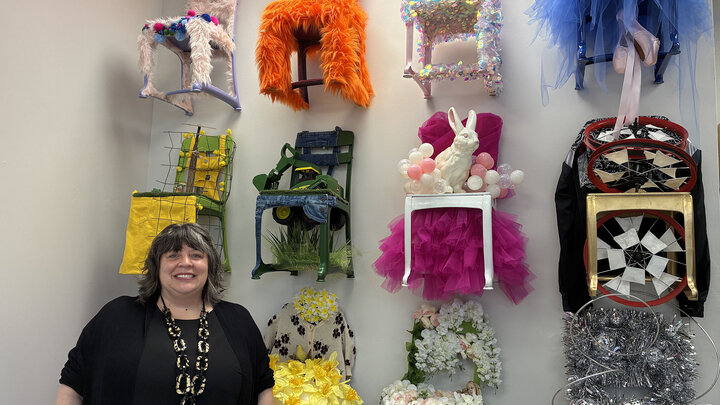
Lincoln, Neb.--For Kimberley D’Adamo, a school chair is more than a piece of classroom furniture. It can be a portrait, a memory and a way to explore the complicated relationships between students and teachers.
D’Adamo, a graduate student in the School of Art, Art History & Design, is transforming vintage school chairs into sculptural works as part of her project, “The Beautiful Impossibility of Teaching Them All.” The project received support from a Hixson-Lied College of Fine and Performing Arts student scholarly/creative activity grant.
Using the grant funding, D’Adamo purchased and transformed 24 vintage school chairs, incorporating garments, spray paint, fabrics, adhesives and found objects. She also expanded the project through digital fabrication, creating 100 small resin chairs through 3D printing, scanning two chairs and 10 additional objects in 3D, and experimenting with transferring images onto fabric.
Each completed chair represents a student — or, in some cases, a composite of students — and is intended to capture something about that student's identity, interests or upbringing. Among the works are “Raver,” “Bike Thug,” “Choir Girl,” “The Farmer’s Son,” “The Farmer’s Daughter,” “Quinceañera,” “Jesus in the Manger at Midnight,” among others.
The idea grew out of D’Adamo’s experience as both an educator and an artist.
“It came about really organically,” she said. “I started my doctoral program here at UNL, and I did a doctorate in education, in teaching learning and teacher education. It was an experimental doctorate, so I was given permission to do an exhibition of artwork.”
That work prompted D’Adamo to think more deeply about her own experiences as a student and teacher and the ways those experiences shaped her approach to education.
“Through that process, I worked on really understanding my own teaching and the roots of my teaching in my own education. There’s a process called Currere by William Pinar and Madeleine Grumet where you look back at your own education and delve into how that has shaped your own teaching,” she said. “And so that left me with this exhibition of work and just a lot of thoughts about how I really felt like art was a way of talking about things in education that we haven't necessarily delved into enough as a vocabulary. There's some things that you can talk about through art that are harder to put into words.”
D’Adamo joined the MFA program at UNL to continue exploring those ideas through art. At the time, she was also thinking about the challenges facing public education.
“I was really feeling very down about public education and how it's being treated within the press,” she said. “I'm a lifelong proponent of public education. And I was a teacher for 22 years including 17 as a high school teacher.”
D’Adamo wanted to use the language of contemporary art to examine education in a different way — not simply focusing on its challenges but also celebrating the experience of teaching and learning.
“I wanted to work on work that showed, that used contemporary art vocabulary and the gallery, the particular space of the contemporary art gallery, to talk about the joys of education,” she said.
She began by thinking about portraits of her former students and eventually found the vintage chairs that became the foundation of the project.
“I found these chairs, which are more prevalent here in Nebraska, I think, after the pandemic, because people were closing their homeschools from the pandemic and they were selling off their furniture,” she said. “It was a particularly apt moment to gather all these chairs.”
Each chair became a portrait of a student or a collage of students.
“The idea was really to show the breadth of the American student and the interests that they have and the upbringing that they have, the values that they’re raised with, but also the complexity of the American classroom where we are being asked to teach all of these children at once,” she said. “I wanted to make it really beautiful because there’s something particularly democratic and amazing about that task for teachers. It’s a daunting task, but it is also the core of what makes teaching so fun.”
The project also reflects her interest in who is included in education and who gets a place at the table.
“I always think about the table of education and who's invited to the table,” D’Adamo said. “I worked a lot with students who are disenfranchised in some way or another.”
Her interest in classroom furniture also comes from her experience as an art teacher and her awareness of how the physical arrangement of a classroom can affect teaching and learning.
“It's always fascinated with me how changing the place in which a child sits in the classroom, the furniture in which they are asked to sit in, changes the way we can teach,” she said. “That's always been really important to me.”
D’Adamo spent months searching thrift stores for materials that could help her give each chair its own personality. The materials are intentionally accessible, reflecting the everyday world of schools and teachers.
“I spent months thrift shopping. That's where I spent most of the money from the grant was in thrift stores,” she said. “The chairs are expensive, but the rest of the material was mostly from thrift stores or places like Walmart, it was really important to me to be using materials that were accessible to teachers and processes that were accessible.”
The chairs can be installed in different configurations depending on the exhibition space. A full grid recalls the way students are commonly arranged in classrooms, while smaller groupings allow individual works to interact through contrast and proximity.
“So right now they're arranged in a grid, partially for storage, but partially because it reminds me of the way that kids are often seated in classrooms,” she said.
The title of the project points to the tension at its center. Teachers are expected to know and support every student, even when the sheer number of students can make that nearly impossible.
“I think it’s just this idea that we're tasked with teaching all of the students in our classroom,” D’Adamo said. “And so, there's an impossibility to this idea that you're going to be able to drive every student's learning simply through sheer charisma and relational goodness.”
But that impossibility is also what makes teaching beautiful to her.
“I think it's also a really beautiful task,” she said. “A lot of incredible things happen in the American classroom that are often overlooked. Teachers are doing amazing jobs all the time with this impossible burden that they are faced with.”
The chairs also raise questions about how teachers come to understand their students. D’Adamo said reducing an entire person to a few objects can risk reinforcing stereotypes, but that process also reflects the complicated work teachers do as they try to build relationships with students.
“I think there's something about stereotypes that also has come up in making the chairs because you're distilling a whole child down into a few objects and that results in perpetuating stereotypes,” she said.
At the same time, teachers often must construct an understanding of their students from small pieces of information about their lives.
“You're really relying on your prior knowledge that they'll give you small pieces of information about their family life or their daily life or the things that they love doing,” she said. “And you're constructing like a whole model of who that kid is in an attempt to really reach them.”
For D’Adamo, the project has blurred the boundary between her identities as an educator and an artist.
“I think they intersect a lot more fluidly than they did before I started making this work,” she said. “The idea of making the classroom itself my studio and the source of all of my work, I think made it so that there was much more overlap between the two pursuits.”
The Hixson-Lied grant made it possible for her to create the project at its current scale.
“I have 24 total, and I'm debating whether to do 34 because that's a more common number of students for a high school class,” she said. “And they were entirely possible because of the grant. I mean, I would not have been able to do this work without the grant at all.”
In her grant report, D’Adamo wrote that the funding enabled her to create a full class set, allowing the project to operate “as a system rather than a single object.” It also supported the integration of digital fabrication and has given her a professional-level body of work for future grant applications and residencies.
The work is still evolving. One chair was recently exhibited in the Medici Gallery, and D’Adamo plans to complete the series and install it as part of her MFA thesis exhibition.
Ultimately, however, she hopes the chairs will move beyond the gallery.
“I'd really love to see it in a library or a school and around kids and teachers,” she said. “I'd like to see it installed somewhere where kids and teachers could talk about it and use it for their own conversations about who the kids are and what they bring to the table. That would be my dream.”
For D’Adamo, the project is both an artistic exploration and a way to make visible a part of education that can be difficult to capture.
“I'd really like to have teaching be more of an explored theme within the contemporary art world,” she said. “I have this privileged moment where I can do that. So that's my responsibility and my hope.”