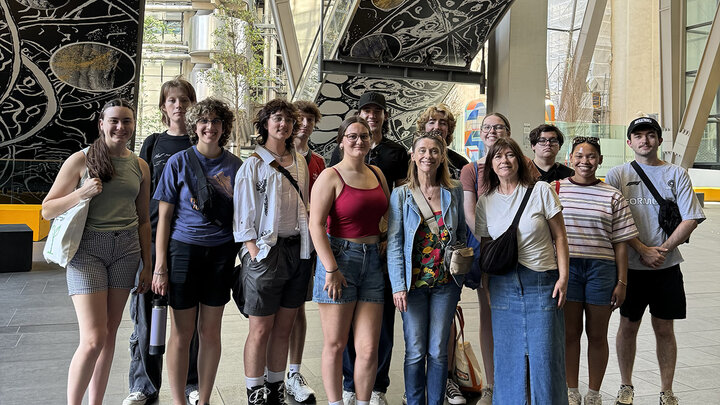
Lincoln, Neb.--This summer, the streets, theaters and neighborhoods of London became more than sightseeing destinations for emerging media arts students. They became classrooms, creative laboratories and meeting places where students discovered new ways to tell stories—and new ways to see themselves.
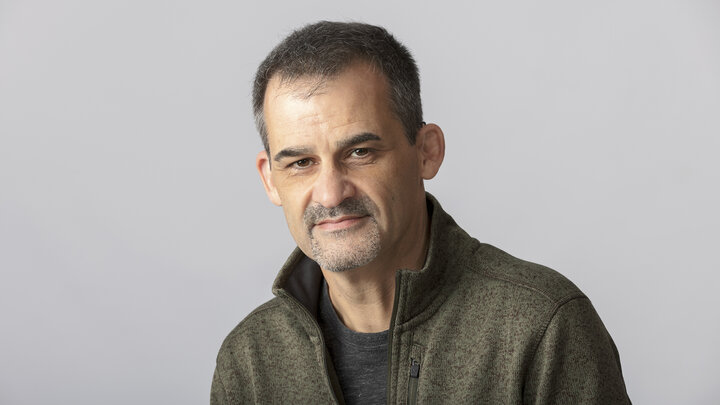
The study abroad course, Story Abroad: City as Story Space in London, led by Assistant Professor of Emerging Media Arts Bryan Jackson, immersed students in one of the world's great cultural capitals. Rather than learning solely in a traditional classroom, students explored London's theaters, museums, galleries, libraries and community spaces while creating original short films inspired by the city and the people they encountered.
The experience was designed to expand students' understanding of storytelling while introducing them to artists working at the highest levels of their craft. Along the way, students forged professional connections, gained confidence navigating an unfamiliar country and developed a broader understanding of how creative work transcends borders.
"Story Abroad London deepens students' understanding of storytelling and expands their sense of what is possible," Jackson said. "It's a course where learning unfolds in the streets, theaters, galleries, museums, libraries, and community centers of London—a world capital of art and culture."
That philosophy shaped every day of the trip. Students participated in workshops with Sara Ellis of the Royal Shakespeare Company; Courtney Tylor Deyn and Jacob Samuel of Bullyache; and artists Jane and Louise Wilson. They also visited the House of Annetta, a historic community space that became a recurring point of reflection throughout the course.
For emerging media arts senior Meredith Koehler, the trip marked several firsts.
"I had never been abroad before and knew this would be the perfect opportunity to do so," she said.
Some of the most memorable moments came through direct conversations with professional artists.
"Some highlights of both the class/overall experience was the opportunity to talk to the cast of both ‘1536’ and ‘Redcliffe’ after their shows," Koehler said. "We got the opportunity to do a Q&A with a few of the actors from ‘1536,’ the writer of the play, and the sound designer which was a surreal experience. We then were able to chat with the cast of ‘Redcliffe’ after their show as it was their first public performance of the musical and they wanted to talk to those who had seen the show. Another highlight for me personally was visiting the city of Richmond over the weekend and going to the pub that was in the show ‘Ted Lasso.’”
Jackson said those conversations with practicing artists became some of the course's defining moments.
"The highlights of the trip were the powerful connections between students and guest artists," he said.
The networking worked both ways.
"I hope they've gained a greater sense of seeing themselves as members of an international community of artists engaged in a rich creative dialogue," Jackson said. "Many of the artists we met with were equally curious about the students, the Johnny Carson Center for Emerging Media Arts, and Nebraska."
While students spent much of the trip learning from established artists, they were also challenged to create original work of their own.
Students produced short audio-video projects inspired by the city, using footage and sounds collected throughout the trip. The projects explored how London's history, architecture and people influenced each student's personal approach to storytelling.
Emerging media arts senior Marley Svoboda was drawn to the course because of its emphasis on narrative.
"I have a passion for storytelling in many mediums," Svoboda said. "Storytelling is at the heart of all of my creative expression. When I found that the class would be led by filmmaking professor Bryan Jackson, I knew it would be a valuable asset to my academic career."
The creative freedom of the assignment encouraged students to interpret their experiences in distinctly personal ways.
"We were exposed to lots of new things and encouraged to run with them in whatever direction we wanted," Svoboda said. "The assignment was to make a short audio-video project using clips we gathered on the trip. The project was supposed to be related in some way to how being in a new, very historic, place inspired our storytelling. We had a screening of the final projects in a local theater, and it was amazing to see the different interpretations of the prompt."
Jackson said the finished films reflected just how transformative the experience had been.
"You could see the impact of the trip experiences on the films the students made for the course," he said. "I was moved by the range, honesty, and emotional depth of the films produced in just two weeks. We celebrated their accomplishments with a screening of their films at the Close-Up Film Centre—an independent film archive and theatre in the Brick Lane community."
Beyond artistic growth, students said living and working in another country challenged them to become more independent while developing a deeper appreciation for other cultures.
"I think studying abroad is important as it allows individuals to open their perspective on different parts of the world and step out of their comfort zone," Koehler said. "I wanted this international experience in order to understand how a different country interacts with the fine arts. This class did broaden my view of what's possible career-wise in emerging media arts, specifically how important it is to stay true to myself as I find my future career.”
For Svoboda, the experience transformed places she had only known through books and media into real communities filled with people whose lives both differed from and resembled her own.
"I think studying abroad and traveling in general are important because it gives you a sense of independence and accomplishment," she said. "Even more than that, traveling helps to make the rest of the world real. This sounds silly, but before you travel to a place that you've only ever heard about, it feels about as real as the moon. You know it exists, but it's really just a concept. Once you meet the locals and really get to know their lifestyle, the place is no longer abstract. Traveling breaks down cultural barriers, and it has made me a more understanding and inclusive person."
Jackson believes those lessons are increasingly important for students entering creative industries that operate across borders.
"International experiences like this study abroad course are essential for students who are staking out their place in the world and learning to see themselves as in the middle of everything," he said. "It's critical they see themselves and their creative works in context of the international marketplace of ideas."
For Koehler, the opportunity was made possible in part through scholarship support, making an international experience accessible to students who otherwise might not have the chance to participate.
"To the donors that make these scholarships possible, your gratitude does not go unnoticed, and these scholarships allow so many people opportunities that they would not be able to do otherwise," she said.
For Koehler, the most enduring memory isn't tied to a single landmark or performance, but to experiencing the city alongside classmates.
"Whether it be going on the tube or walking from activity to activity, spending time with my friends and just having the opportunity to really soak in the city was such an incredible feeling that I will never forget."