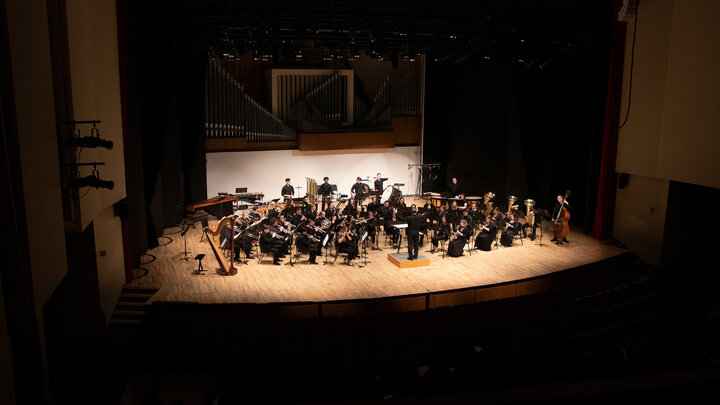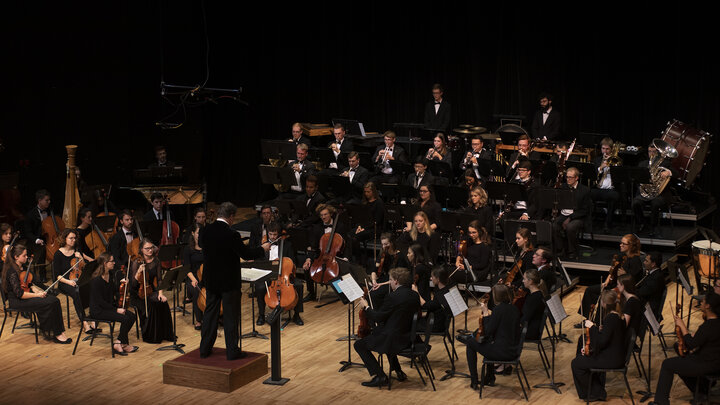
Lincoln, Neb.--The UNL Symphony, along with University Singers, University Chorale and Varsity Chorus, will perform Beethoven’s Symphony No. 9 on Saturday, April 18 at 7:30 p.m. and Sunday, April 19 at 3 p.m. at College View Church.
The concert is free and open to the public. The church is located at 4801 Prescott Ave. in Lincoln.
Widely recognized for its final movement, often referred to as “Ode to Joy,” the symphony remains one of the most significant works in the Western canon.
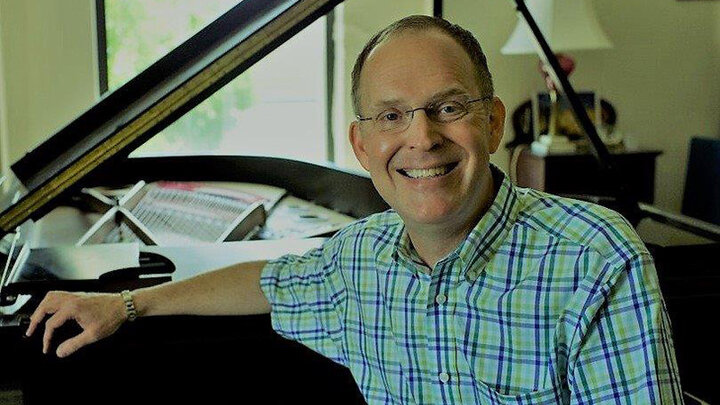
“’Beethoven’s Ninth is one of the touchstones, the cornerstones, of Western civilization,” said Tyler White, professor of composition and conducting and director of orchestras in the Glenn Korff School of Music and the conductor of the UNL Symphony. “More than any other musical work, it is seen to represent the predicament and the promise of humanity in a really universal way.”
White said that the symphony’s first three movements explore a sweeping range of human emotion.
“You could summarize the first three movements as the pain and the power and the beauty of being alive. Those first three movements leave the question open—what’s it all about?” he said. “And then the last movement provides this incredibly stirring answer that the whole world was made for joy.”
The performance will feature approximately 160 to 170 performers on stage, a significant expansion from the symphony’s typical 60 to 70 instrumentalists. The added forces come from the combined university choral ensembles, creating a large-scale collaboration that reflects the grandeur of the work.
“It’s always an incredible privilege, as well as a pleasure, dealing with this music,” White said. “This is music that demands the most of all the performers and of conductors. Beethoven was famously unkind to singers. He writes parts that are high and that stay high for long periods of time, or they are intensely dramatic.”
The instrumentalists fare no better.
“For the instrumentalists, he’s constantly engaged in stretching their capabilities and stretching what their instruments can do.”
Those challenges, however, are what make the work rewarding.
“The whole experience, when it comes together, it’s almost unlike any other,” White said. “Beethoven is famous for writing triumphant endings, and this piece is no exception. But one of the important things about his triumphant endings is that they’re not crushing one’s enemies. They’re about achieving a kind of freedom that brings something very much like ecstasy, and this piece is the ultimate example of that characteristic of Beethoven’s creativity. There’s something about the amount of effort it takes to pull this creation off is what brings that ecstatic sense of triumph.”
The program will feature three guest soloists, who are all alumni of the Glenn Korff School of Music. Baritone Charles Austin returns after an international opera career. Tenor Alfonzo Cooper is assistant professor of music (voice) at Tuskegee University in Alabama. Mezzo Soprano Adrienne Dickson is adjunct faculty at Concordia University in Nebraska.
“Adrienne is a well-established teacher here in Lincoln and has also memorably performed with the orchestra and UNL choirs in 2013 in Verdi’s ‘Requiem,’” White said.
This performance of Beethoven’s Ninth Symphony completes the cycle of the UNL Symphony performing all nine of Beethoven’s symphonies in the last seven years.
“The Beethoven symphonies are at the core of the symphonic repertory, and they include at least three of the most influential symphonies ever written—the Ninth, of course; as well as the Third (the Eroica), which really reshaped the whole symphonic form for the 19th century; and then the Fifth, the most famous symphony in the world,” White said. “But all of the symphonies are absolutely masterful and absolutely wonderful. It’s just essential for any young musician’s education to get experience playing these works. It’s also important for audiences to be reintroduced to these familiar works and get reintroduced even to the ones that are less familiar.”
The works are foundational, White said, and not unlike a devotee of rock and roll listening to the Beatles or Elvis Presley.
“The legacy of the greatest works is inescapable,” White said. “And so, for Beethoven, that legacy is, likewise, inescapable. The energy and the power of Beethoven’s creativity always seem to find a way to generate enthusiasm among new audiences. There’s a reason that Beethoven is in the canon and forms such a core of the canon.”
A distinctive feature of this performance will be White’s own English translation of the symphony’s choral text, originally written in German by Friedrich Schiller. Developed over more than two decades, the new translation aims to remain faithful to the original while functioning as a singable English text.
“I don’t claim for this translation any universality,” White said. “Nothing can compare with Beethoven’s original setting of the German. My translation is not a work for all times and places, but I think for this time and place, it can be particularly appropriate. We live in such a divided and broken time that speaking to American audiences in their own language, I think, can be enormously powerful. My hope is that the performance will be uniquely exciting in that respect.”
The students in the orchestra have embraced the challenge of Beethoven’s Ninth Symphony.
“The orchestra has made progress by leaps and bounds,” White said. “And they’re really getting at playing with tremendous vigor and accuracy. I’m proud of them. We have our first rehearsal on Friday [April 10] putting instruments and voices together, and I can’t wait for that.”
For audiences, White said to expect an experience that goes far beyond a typical concert.
“What one always expects and hopes for from performances of the Ninth Symphony is an absorbing, enthralling, uplifting experience that goes way beyond ordinary concertgoing,” White said. “Performing this work, even hearing this work, can literally be life changing.”
White told the famous story of the symphony’s 1824 premiere, when the deaf Beethoven was unable to hear the audience’s thunderous applause until a soloist turned him toward the crowd. For White, that moment captures the essence of the piece—total immersion in a transformative, artistic experience.
“That’s what the Ninth Symphony is all about,” he said.
Following the Lincoln performances, the UNL Symphony and choruses will travel to Hastings on April 26 and perform at 3 p.m. in Hastings City Auditorium in collaboration with the Hastings Symphony and the Hastings College Choir, as part of a celebration of the 100th anniversary of the founding of the Hastings Symphony. White is the artistic director and conductor of the Hastings Symphony.
That concert will feature the Nebraska premiere of an expanded orchestration of the symphony by Gustav Mahler, resulting in an even larger ensemble of more than 100 instrumentalists and 200 vocalists.
“That should be a great experience,” White said. “It’s always remarkable to me that a town of 25,000 people in the middle of Nebraska can manage to keep an orchestra going for 100 years. It’s absolutely wonderful and a tribute to the citizens of Hastings and central Nebraska. We will put that together and look forward to the next century.”
For ticket information for the Hastings concert, visit https://go.unl.edu/hastings100.
Despite the scale and complexity of the work, White emphasized its enduring relevance.
“The Beethoven Ninth is inexhaustible,” he said. “This is a work that can accompany a listener through an entire life and forms a never-failing source of inspiration and joy.”
In Beethoven’s original setting of the last movement, the German word for joy, “Freude,” is central.
“With everything that’s going on in the world right now, we could all use a little more Freude,” White said.