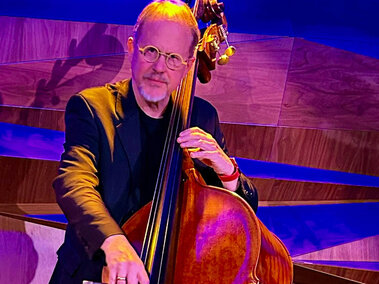
Hans Sturm in performance at The Jewell in Omaha. Courtesy photo.
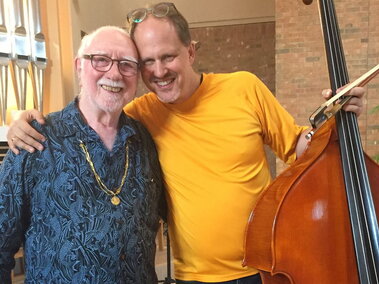
Hans Sturm (right) and François Rabbath in St. Paul, Minnesota, in 2015. Courtesy photo.
By Kathe C. Andersen
Hans Sturm, Glenn Korff School of Music professor of bass, retired this spring after 14 years of service. Many factors went into this being the right time for him to retire.
“It’s not any one thing,” he said. “I’m turning 65, so the age is right, and we’ve been saving for a long time. There is also an ethical point to this. If I continue to teach for another 15-20 years, then I don’t vacate a place. If I’m teaching doctoral students, there has to be a place for them to be, so that’s a big piece of this. But also, we want to travel, and there are some ongoing projects that I would like to spend some more time on.”
Sturm has performed as a soloist, chamber, orchestral, jazz and improvisational musician throughout Europe, Asia, South America, Australia, Africa and the United States. He has served as president of the International Society of Bassists and recently wrote a biography of his mentor, “75 Years on 4 Strings: The Life and Music of François Rabbath.”
He appreciated the culture he found in the Glenn Korff School of Music.
“Coming here and being in a place that was so healthy and supportive, I was able to develop a big, robust studio here,” he said. “I’ve had support from both the school of music and the college.”
But he will also miss the people.
“I will miss the interactions with the students,” he said. “And we get busy, but I’ll miss the interactions with my colleagues. I’ll keep in touch with a lot of them. I played quite a bit with several of them, subbing with the Lincoln Symphony, but also with Darryl White, Tom Larson, and others.”
Tom Larson, the Steinhart Distinguished Professor of Music, said he will cherish the times he collaborated with Sturm.
“Having Hans Sturm as a colleague for the last 14 years has been my honor and privilege,” he said. “We’ve recorded two duo albums together, performed in Copenhagen and Paris, collaborated on five recitals, written music together and played numerous gigs around the Lincoln-Omaha-Kansas City area. I’ve never played with anyone who possesses as much musical creativity and empathy as Hans, regardless of whether we’re performing in a nightclub or at a church service.”
Max Stehr (D.M.A. 2016), said he first heard of Sturm in 2012 when he was applying for doctoral programs and found Nebraska was one of only a handful of programs that offered a doctorate in jazz.
“Nebraska was not a place I ever considered moving to, but after looking into the program and Dr. Sturm, it started to seem like this is where I needed to be,” he said. “Hans checked all the boxes I was looking for in a teacher. He was playing at a high level as both a classical and jazz musician, he was a protégé of Richard Davis (one of my bass heroes), he had an understanding and respect for modern classical music (a passion of mine), and he had a deep knowledge of bass pedagogy and technique. I flew out for an audition and hit it off with Hans and the whole jazz department. Within a space of a few short months, I went from ‘They play jazz in Nebraska?’ to ‘Honey, it looks like we’re moving to Nebraska.’”
He appreciates the growth he experienced under Sturm’s guidance.
“As a doctoral student, the expectation was that you were already a developed musician before entering the program, and I certainly came in with confidence in my abilities as a jazz musician (maybe too much),” Stehr said. “I realized later that I may have been a musician when I got to UNL, but Hans helped me understand what it meant to be a bassist. I had always thought of myself as a musician first, and bass was simply the medium I used to make music. Hans opened my eyes to the world of double bass. Repertoire, technique, different bass makers, different string types, how to perfect your sound, how to play in a bass section, the culture of the orchestral bassist. All things I had never been exposed to before. He created a wonderful bass studio with students who were excited about the bass.”
After finishing his doctorate, Stehr ultimately ended his professional career in music and pursued other avenues.
“But I look back at my time in Nebraska as one of the best and most fulfilling periods in my life, in no small part thanks to Hans. He brought me to Nebraska after all,” he said. “He should be proud of the studio and culture he built at UNL. I was certainly proud to be a part of it.”
Sturm loved his job.
“There’s that Mike Rowe on that TV show ‘Dirty Jobs,’ who always said take the job that nobody else wants to do because then you’ll make all this money. I subscribe exactly to the opposite,” he said. “Both of my parents were teachers, and so it’s seeing students blossom and watching those ‘a-ha’ moments that are absolutely magical. But in addition to that, it’s what I learned from them. I take a lot from the students as what they give to me. It’s been wonderful.
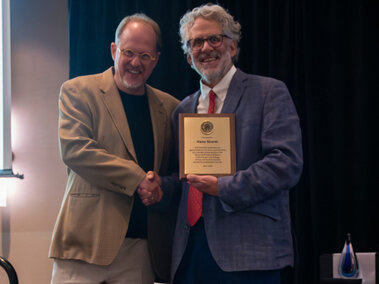
Hans Sturm’s retirement was recognized by Dean Andy Belser at Honors Day on May 2.
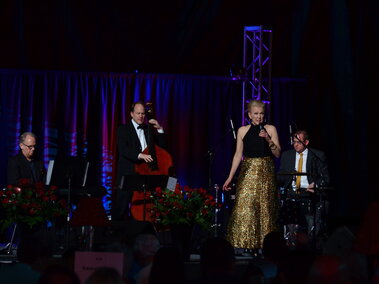
Left to right: Tom Larson, Hans Sturm, Jackie Allen and Dave Hall perform at the Lincoln Mayor’s Arts Awards. Courtesy photo.
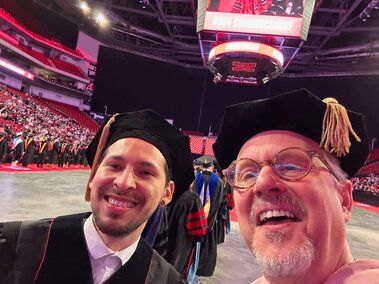
Hans Sturm with Dr. Javier Barreto Olaya at the D.M.A. hooding at Pinnacle Bank Arena in 2024. Courtesy photo.