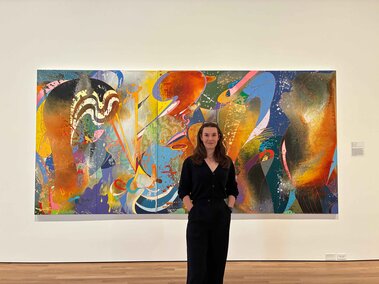
Karissa Johnson stands next to one of her favorite pieces in the collection, Barbara Takenaga's "Round Trip Time." Photo by Kathe Andersen.
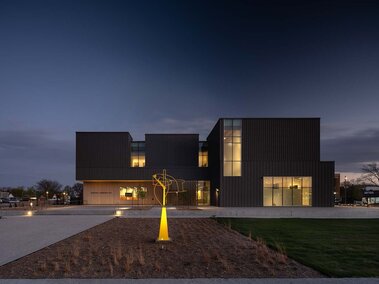
The Museum of Nebraska Art 's four-year, $38.5 million expansion, renovation and restoration was completed earlier this year. Photo by Nic Lehoux.
By Kathe C. Andersen
On May 3, the Museum of Nebraska Art (MONA) in Kearney, Nebraska, re-opened following a $38.5 million renovation, restoration and expansion with five new exhibitions curated by School of Art, Art History & Design alumna Karissa Johnson (B.A. 2017). Johnson became MONA’s curator on June 21, 2021, while the museum was in the middle of planning for the renovation. The museum closed in November 2021, until its reopening this spring. The project included a comprehensive restoration of MONA’s existing 25,000 square feet and the addition of a new 23,000-square-foot wing.
“When I saw the job posting, I knew MONA from some of my past experience, but had no idea that they were working on this project,” Johnson said. “It was an interesting time to come on board because while a lot of the vision and the design for this project was well underway, there were a few things that they had been holding back hoping to get a curatorial perspective on.”
MONA celebrates the state’s artistic culture and heritage by collecting and preserving, exhibiting and interpreting the art of Nebraska. It serves as the home of the Nebraska Art Collection—a permanent collection of nearly 6,000 pieces reflecting the state’s history.
The museum’s opening exhibitions included “Magic and Loss: Charley Friedman and Nancy Friedemann-Sánchez,” “Eliza Hardy Jones: Song Quilts,” “Plein Air Paintings from the Flatwater Folk Art Museum,” a photography exhibition titled “Wesaam Al-Badry: The Labor of Belonging,” and “In Search of Ourselves: A Reinstallation of the Museum of Nebraska Art’s Permanent Collection.”
“For about every art form that you can imagine, I can find a Nebraska artist who is engaging with it. I find that endlessly exciting,” Johnson said.
“Karissa is amazing,” said Professor of Art Aaron Holz, who attended the museum’s early preview celebration in April. “She is thoughtful and researched in her curation. The task of choosing works, providing context through labels and relationships of each work is no small undertaking, especially in a major expansion with all eyes on that selection. She did a wonderful job, and we are fortunate to have her at MONA.”
He was impressed with her curatorial choices.
“I was really impressed by seeing works that, in some cases, languished in the old space and now suddenly feel new and relevant,” Holz said. “There is an early Dan Christensen next to a Sheila Hicks that just sings. It’s really a testament to good curation.”
Johnson’s love of Nebraska art and artists drew her to the position.
“That’s where my background was the heaviest,” she said. “I grew up in Nebraska, and I was one of those kids that just could not wait to get out of Nebraska because it felt like it was chosen for me—like my parents picked this place for me. I didn’t know if it was the right fit for me, and I was determined to get out for college. And then I got a Regent’s scholarship from the University of Nebraska–Lincoln and just could not say no to a free education. Still, though, I was kind of always looking for that exit door, but something happened over time.”
She came into the University of Nebraska–Lincoln as an undeclared major but soon found her major in art history in the spring semester.
“I had a high school teacher who was encouraging me to consider accounting. I had another one encouraging pharmacy. I knew I didn’t even know half of the options out there in the world, so I was hesitant to commit,” Johnson said. “I just started taking my ACE credits, and it was my spring semester of my freshman year that I enrolled in an art history class. I think when I saw it in the course offerings, I must have flashed back to watching ‘Mona Lisa Smile’ and thinking, ‘Yeah, I want to be Julia Roberts, who doesn’t?’ I took that class with Professor [Alison] Stewart, and it immediately clicked. It was the first time in my life that I was excited to study because I genuinely wanted to know the material. I wanted to be able to walk through a museum and understand the significance of what I was seeing.”
By the end of her sophomore year, she started working at Kiechel Fine Art Gallery.
"There, I worked with 19th and 20th century American art, artist estates, as well as contemporary art," she said. "Working with contemporary artists really opened my mind to everything Nebraska had to offer.”
Johnson received her Master of Arts in art history and museum studies from the University of Denver, where she had internships at the Denver Art Museum and Bemis Center for Contemporary Art in Omaha and was a museum assistant at the Madden Museum of Art in Denver. She didn’t necessarily intend to move back to Nebraska.
“I didn’t really have any plans to come back, but I found myself getting to know the Denver art community, hearing about different programs, and visiting the different galleries and museums,” she said. “And I kept looking at what they were doing and found myself thinking, I wonder if that would work back home? I wonder if that’s something I could bring back and do in Lincoln or if that would benefit Nebraska artists? At a certain point, it dawned on me that I had unfinished business back home. It felt like my primary audience and service was to Nebraska artists. That’s who I really wanted to work with and for.”
When the MONA position opened, she waited a bit first before finally applying.
“Then I thought I’ll throw my hat in the ring, and we’ll see how marketable I am now that I’m getting ready to complete my master’s,” she said. “I was the local candidate, and I think they were really excited about somebody who could come in already familiar with the art scene. I still walk around and feel like I have to pinch myself that they let me take all of this on. What a leap of faith the museum’s leadership had to take on me because it’s a really big job at such a crucial time.”
The renovation nearly doubled the exhibition space at the museum, and envisioning the new space was exciting.
“Building the physical infrastructure of a space creates your physical limitations of what you can do. It was an interesting experience working with the architects because they need something tangible to respond to. I kept telling them I need more, I needed bigger,” she said. “They kept asking, ‘But what do you need?’ I needed to give them something to actually respond to without knowing what Nebraska artists are going to throw at me. I don’t know what they’re going to be doing in 5-10 years, let alone 30-40 years. I want us to be able to do it all. I want to be able to work with all of them as much as we can.”
With the renovation, MONA also doubled their collection storage space.
“We built a whole new storage room and right now it’s housing essentially the entire collection. We also revamped the existing rooms so we can essentially double the collection before we have any capacity issues again,” she said. “I’m not rushing to fill it up, but it’s really exciting.”
Johnson knows she is the curator at a significant moment for the museum.
“Next year is 50 years as a collection and 40 years as a museum, and this expansion is significant. It rivals when the museum first opened its doors in 1986,” she said. “The responsibility of being the curator at this moment is tremendous. That said, I have a great love and respect for Nebraska artists. I want the museum to be a space that really honors them. I think it comes from a responsibility to do this work because we can’t count on anybody else to do it. As incredible as the Whitney biennials are at offering a glimpse of what contemporary American artists are doing today, they don’t look at Nebraska. The same with the Museum of Modern Art. They’re not looking here. We have the responsibility to uplift the artists that are living and working here and to do that work ourselves. When I looked at our mission, because it was something I really had to grapple with when I first got here, Nebraska art felt so broad and open, but also a little bit limiting. I was finally able to think about it clearly when I started to look at Nebraska art like a cross-section of American art. There’s the Smithsonian American Art Museum or the Whitney Museum of American Art. I want the Museum of Nebraska Art to be that, but exclusively for Nebraska artists. That framing really clarified things for me. We’re here to show excellence and to record Nebraska’s art history.”
Holz agreed that Nebraska artists have earned that recognition.
“It’s easy to miss the contributions that Nebraska artists have made beyond the region,” he said. “So many people driving through the state think of corn and soybeans, cattle, football and maybe Warren Buffett. When the Whitney Museum of American Art reopened in May 2015, one of the main paintings showcased was of Gertrude Vanderbilt Whitney, founder of the Whitney Museum. Well, that was a commissioned portrait by Robert Henri, leader of the urban realist painters and a Cozad, Nebraska, native.”
One change Johnson made was to present the permanent collection thematically rather than simply chronologically.
“I wanted to look at it in a different way because there are a lot of problems when you’re presenting the collection chronologically. The first of which is pretending that Nebraska art begins with European American expansion and settlement, which was always the impression when our collection opened with the Artist-Explorer era,” she said. “Whenever we tell these stories in an exhibition, a lot gets left out just out of necessity. I don’t want anyone to walk away from the museum thinking they’ve somehow now received the complete story of Nebraska art because it’s just not possible to do that. We need to rotate. We need to change. We need to get farther and farther into the collection and show the depth of what we have because there are so many stories, and as we continue to collect, we’re just adding more and more stories.”
Johnson loves her work.
“I find myself doing this work and often thinking to myself, wow, this is my job,” she said. “Someone actually pays me to do this, and I feel like I would do it for free if I didn’t have to pay rent. I feel very lucky.”
It’s been a big year for the visual arts in Nebraska, with the reopening of the Museum of Nebraska Art in Kearney and the reopening of Joslyn Art Museum in Omaha in 2024, following their $100 million renovation and expansion.
“The visual arts in Nebraska are having a special moment,” Holz said. “The expansion of both the Joslyn and MONA stand out, but we also have new staff at the Sheldon with exciting programming outside of the collection, private collections that are mounting major public exhibitions, expanded programming at the Bemis Center for the Arts—the list goes on. It really is an exciting time and so wonderful to have an alumna from our art history program who is contributing to this moment in such a thoughtful and impactful way.”
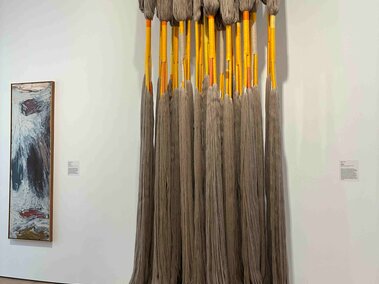
Dan Christensen's "Thor's Wife" (left) next to Sheila Hicks' "Menhir II" in the permanent exhibition gallery at MONA. Photo by Kathe Andersen.
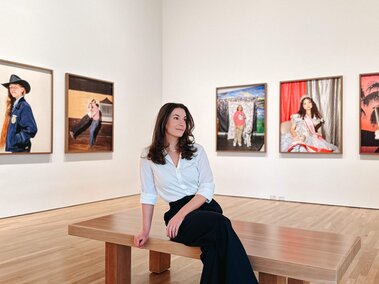
Karissa Johnson at MONA. Photo by Alanna Metzger.