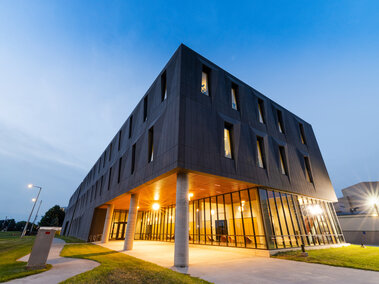
The new music building evening shot. Photo by Elizabeth McCue.
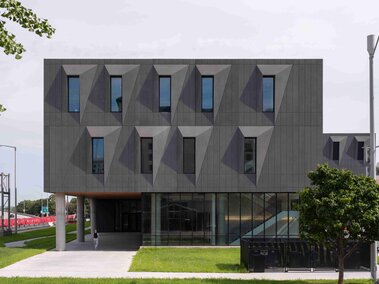
The new music building is located at 10th and Q streets on the southwest corner of the campus. Photo © Hannah Gray. Photo courtesy of BNIM.
By Kathe C. Andersen
The Glenn Korff School of Music has a new home this fall at 10th and Q streets. The $81 million, 103,000-square-feet, state-of-the-art facility opened in May, began holding classes this fall and will keep the historic Westbrook Music Building name.
It replaces the former Westbrook Music Building at 11th and R streets, which opened in 1967.
“It’s an incredible mix of positive emotions,” said Glenn Korff School of Music Director Felix Olschofka. “On one hand, there’s deep satisfaction in seeing this long and complex journey come to life. So many people—faculty, staff, students, architects, construction crews and campus leadership—invested time, energy and vision into this project. Walking through the finished space now, hearing music in the halls and seeing students settle into their new creative home is deeply moving. At the same time, this moment marks a beginning. We didn’t just build a facility—we created a platform for a new era of innovation, interdisciplinarity and artistic excellence. The building opens doors, not just physically, but programmatically and imaginatively. It’s exciting to think about what new kinds of music-making, teaching, research and community engagement will happen here.”
The building was made possible with $75 million in support from the Nebraska Legislature through LB 384, a deferred maintenance bill that, in part, extended the University of Nebraska Facilities Program to complete multiple building project upgrades statewide. An additional $15 million was allotted for the renovation of Kimball Recital Hall.
“I believe the university is our most valuable resource in Nebraska, and we should ensure that we attract the best and brightest teachers and students,” said former Nebraska State Senator John Stinner, who was the head of the legislature’s budget-writing Appropriations Committee when the bill passed in 2021. “Maintaining the infrastructure is critical to that mission. We in the legislature are very proud of what our university stands for and its accomplishments and feel it was a privilege to be a part of this project.”
The architects for the building were BNIM of Kansas City and Sinclair Hille Architects of Lincoln. Kirkegaard Associates was the acoustics design firm.
Joyce Raybuck, BNIM principal and project designer, said the building was designed to be different.
“I think the exterior presence is striking because it’s different than what is around it,” she said. “When we designed it, we were taking contextual cues. For example, on the western side, we were taking proportioning from the adjacent building, in terms of height and some of the horizontal datum lines. We did want something that stood out but felt like it was part of the campus. Like a musician’s performance attire, it has a formal presence. We also wanted it to feel welcoming to diverse publics. One of the things we did was to add glass at key entry points, helping to break down the scale. We also added performative eyebrows to the windows, which help with shade and shadow throughout the day. The building performs sustainably and is a performance in and of itself.”
Raybuck said the new building addressed feedback they received at the beginning of the project from faculty and students that they wanted more light and social spaces inside.
“As architects we generate ideas for our clients, and ideas come out of user engagement. They really wanted this new building to be healthy. They wanted it to have ample daylight. They wanted social spaces to have a sense of community,” she said. These ideas “set the stage for this building and got translated into
the space. For us, one of the highlights is watching people enter the building. Many say, ‘Wow, look at all the daylight, look at all the views,’ and they immediately see the connectivity. Making a sustainable building and seeing that come to fruition in a way that is beautiful is very meaningful.”
David Quade, Sinclair Hille principal, project architect and the project’s coordinating professional, said the first floor was designed to be the primary public space of the building.
“The large rehearsal rooms and more public-oriented programmatic elements of the design became ground-level anchors at the edges of the clerestory volumes,” he said. “The large open-circulation pathways between these spaces connect the building to the campus arts quad at the northeast and the city of Lincoln at the southwest through large transparent window assemblies and a large covered porch. We really wanted to activate and enliven this primary community circulation core and invite people to experience the music and creativity of the college whether they linger or simply move through the space.”
Raybuck said, “We have intentional sound bleed from the practice rooms. So, while you’re in the practice room, you won’t hear it, and you can focus. But when you’re walking through public spaces, people will literally hear music and know this is a creative place—a school of music.”
Raybuck is looking forward to seeing how faculty and students use all of the spaces in the new building, including the study bridges throughout the second and third floors.
“I think what will be interesting is to see if they end up using it for performances in a different way than intended,” she said. “I know we had some presentations to the faculty throughout the design process, and I remember faculty asking if the bridges had been designed for performance. In the end, it’s the school’s building, and we hope that they do creative things with the bridges and other spaces. I could just imagine an interactive kind of performance could be really special. We also purposely put student spaces by the faculty offices so that there might be more chance encounters between faculty and students. We’re hoping that kind of interaction will happen more often because UNL believes that ‘every interaction matters.’”
Tom Larson, associate professor of composition, emerging media and digital arts, said the new building was everything he hoped it would be.
“The acoustic isolation is so much better than the old building. It’s beautiful inside,” he said. “There are so many places in the building where students and faculty can meet up and hang out, something that was completely absent in the old building.”
Paul Barnes, the Marguerite Scribante Professor of Piano, loves the natural light in the new building.
“Even walking up the stairs is fun because you have those awesome giant windows, and that aspect of it is incredible,” he said. “These floor-to-ceiling windows [in the faculty offices] are awesome. I think it’s going to be a great space to teach and to interact with students. It’s wonderful to have attractive spaces to just hang out, and they’re everywhere. I think it’s really going to facilitate people just wanting to be here more. When creative people are around each other, really wonderful things happen.”
Two highlights of the new building are the new recording studio and an immersive performance hall, both located on the first floor.
The performance hall is a unique space for the university.
“A project like this takes the whole team’s focus, but I personally worked on that space with the team, so it holds a special place in my heart,” Raybuck said. “There is no other space like this currently in the United States in a university setting at this scale. It is completely flexible. It can be used for different types of performances, anything from a chamber group to a small-staged opera. We can also use it for a performance that uses technology with immersive video and audio. It also has flexible curtains and retractable risers, so it just gives the school a lot of options. What’s special about this space, too, is it becomes an instrument. We are excited for how the students and faculty will invent ways to use it. It is really a piece of the performance. I hope the physical aspects of the room informs the way that teaching and learning are evolving and that it supports collaboration. We had a number of discussions with the Dean about interdisciplinarity, and we think that this space holds this promise.”
Greg Simon, associate professor of composition and area head for composition, history and theory, could not be more excited for the performance space.
“The Hixson-Lied College has always been collaboration-centered, but we’ve often been hard-pressed to find the right spaces to involve musicians (although we have certainly made do with the generosity of the Sheldon and Carson Center teams),” he said. “This new hall is a brand-new type of space within UNL, and it provides near limitless potential for new collaborations, not just within the arts quad, but with new partners across campus.”
Larson said, “It will be an ideal space for collaboration among faculty and students from the entire Hixson-Lied College.”
Carolyn Barber, the Ron and Carol Cope Professor of Music and Director of Bands, sees great potential for interdisciplinary collaboration in the new immersive performance space.
“By all accounts, it should be amazing,” she said. “Initial thoughts tend toward music and dance collaborations with video/visual artists creating a 3D experience for the audience. I can also imagine collaborations between writers and poets and chamber ensembles with the words projected and enveloping the listeners, or lecture demonstrations that bring the audience virtually into laboratory settings. I think our imaginations will bloom as we get to know the space, hear its acoustic possibilities and get feedback from audiences.”
The recording studio is a brand-new space for the Glenn Korff School of Music.
“The recording studio rivals professional facilities, offering students and faculty hands-on experience with industry-level technology—an opportunity few music schools can offer,” Olschofka said.
Simon said the recording studio will enhance the experience of students
“Not only will it enable us to make great recordings of student compositions, but it will give composers and performers alike experience with the studio environment, which offers a completely different set of challenges than live performance,” he said. “We’re already making plans for recording projects, both in the composition studio and in the jazz studio, and we’re excited about how the space might provide opportunities to create brand new degree programs in production and technology.”
Larson said the recording studio is a “dream come true,” for him.
“Our new studio will allow students to have state-of-the-art recording experiences that were just not possible in our old building,” he said. “I have been teaching two audio recording and production classes and a film scoring class for the last 10 years without the benefit of having a studio for the students to work in, so this new space will be a game changer. It was designed by the world-renowned Kirkegaard Design and Consulting, the best in the business.”
Larson’s spring Music Entrepreneurship class laid the groundwork for a new student-run record label.
“The students named it Broken Elevator Records to honor the legacy of the barely working elevator in the original Westbrook Music Building,” he said. “The label will ultimately be manifested in a two-semester class that will give students real-world experience in all facets of running a label, including signing talent and developing marketing campaigns for album releases.”
Quade said the recording studio provides an opportunity to expand collaboration and capability.
“The performance hall and the other large rehearsal rooms are connected back to the recording studio as well,” he said. “That recording studio is completely new to the school and really provides a fantastic opportunity for interdisciplinarity and interconnectedness with sound engineering, theater and other programs with the potential and desire to expand programs even further.”
Other spaces in the building include two large rehearsal rooms (for band and choir), a percussion rehearsal space, a music library, 16 classroom spaces, 41 practice rooms and 65 offices, among other spaces.
“The huge screen and AV system are in place [in the band rehearsal room]. There will be a system for video recording and/or live streaming that will enable our ensembles to connect with groups around the world,” Barber said. “A goal is to share insights and techniques of the Ensemble Performance Lab (aka the Wind Ensemble) with school, university/college and community groups directly.”
Thanks to the 1% for Art program from the Nebraska Arts Council, the new music building will also have a large art installation installed next March. After a record-setting 165 submissions were received for potential art installations, a committee selected a project by Jacob Hashimoto and Wade Cotton, who collaborate through their art production company Superabundant Atmospheres (superabundantatmospheres.com), to install a work on the first floor in the main lobby and elongated hallway. Their previous work includes “The Sky” at Portland International Airport in Oregon.
“I’m incredibly excited about the new art installation in the music building—it’s a stunning, imaginative work that beautifully reflects the creativity and energy of the Glenn Korff School of Music,” Olschofka said.
“This piece resonates deeply with our values of innovation, expression and interdisciplinary collaboration making it a perfect fit for our community.”
Work now begins on phase two of the project. The south side of the original Westbrook Music Building will be renovated and connected to the new building, providing additional office and classroom space, while the north side of the original building was demolished this summer. Additional landscaping will also be installed to connect the new building to the arts quad. The entire project will be completed by next spring, which is when the official dedication will be scheduled.
“We’re thrilled about the upcoming dedication of the entire new building next spring,” Olschofka said. “This milestone is a major achievement for our community, and we look forward to celebrating. Please watch for more details about this special celebration—we can’t wait to share it with everyone.”
Larson is eager to begin use the new building.
“As someone who went to the UNL School of Music as an undergraduate for two years back in the 1970s, I’ve been studying and working in the old Westbrook for over 50 years,” he said. “The new building is something that has been talked about and planned for many years, and there were times I never thought it would actually happen. It is stunningly beautiful inside, spacious, acoustically sound, and designed for the needs of a 21st century music school. I can’t wait for when students come back and experience all the space, beauty and technology the new building offers.”
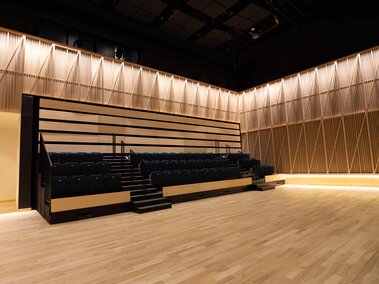
The new immersive performance space is flexible and can be used for any performance that uses technology with immersive video and audio. Photo by Muskan Yadav.
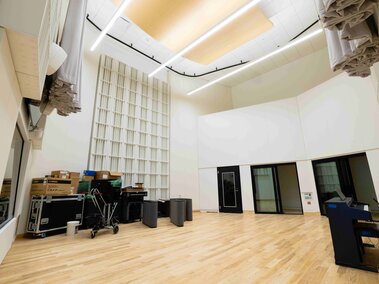
The new recording studio will allow students to have state-of-the-art recording experiences. Photo by Elizabeth McCue.
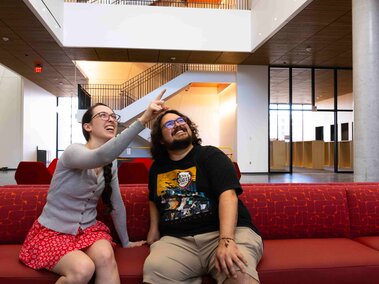
Graduate students Andrea Alvarado Troncoso and Manuel Monge Mata see the new Westbrook Music Building for the first time on May 22. Photo by Elizabeth McCue.
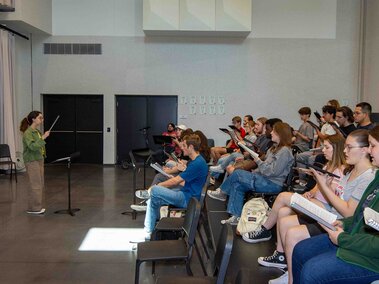
A beginning conducting class meets in Rm. 131a. Photo by Brian Garbecht.
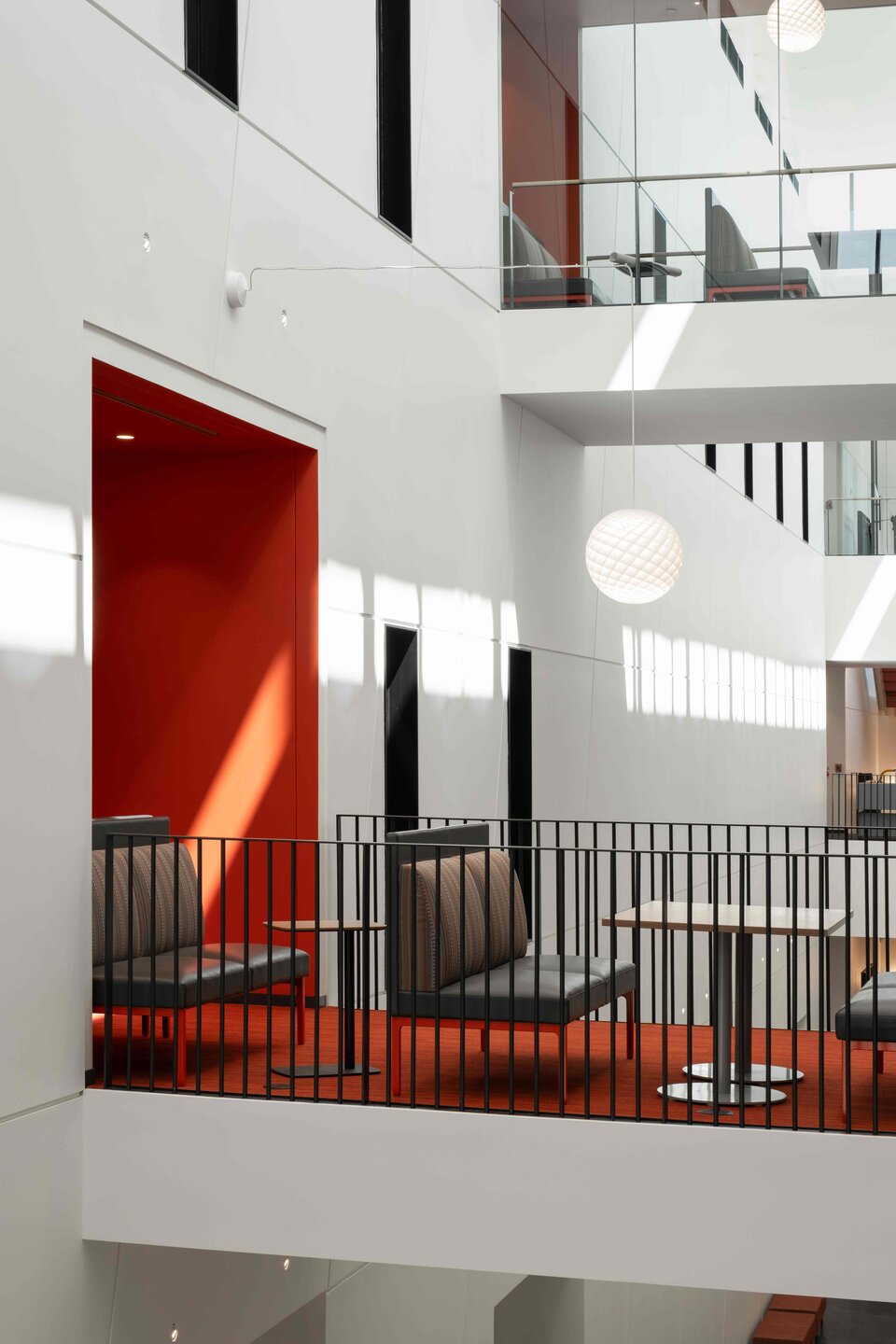
The new music building features several spaces for students and faculty to study or socialize. Photo © Hannah Gray. Photo courtesy of BNIM.