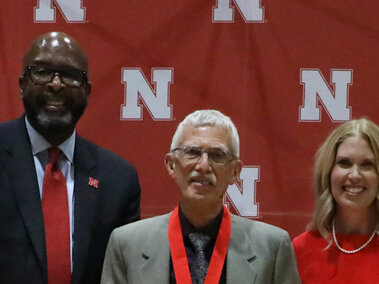
Donald Gorder (center) with UNL Chancellor Rodney Bennett and Nebraska Alumni Association Executive Director Shelley Zaborowski at the Medallion Dinner for Masters Week. Photo by Bailee Gunnerson.
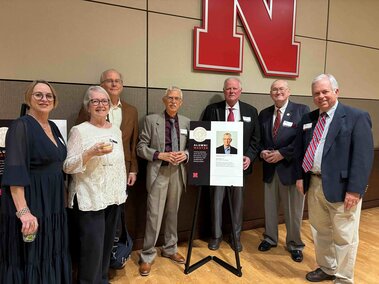
Left to right: DeAnn McHargue, Loretta and Ed Love, Donald Gorder, Stephen Klintberg, Keith Heckman and Keith Bystrom at the Medallion Dinner. Photo by Kathe Andersen.
By Kathe C. Andersen
Donald Gorder (’73) was one of nine alumni named to the 2025 class of Alumni Masters by the Nebraska Alumni Association. He was on campus April 10-11 and interacted with students and faculty in the Glenn Korff School of Music.
Gorder is the chair emeritus and founder of the Music Business/Music Management Department at Berklee College of Music in Boston. He spent nearly 30 years building Berklee’s music business program into a national leader, retiring in 2021. He is also a performing musician and practicing attorney.
“It’s a great honor,” Gorder said of being named an Alumni Master. “I’ve met my co-honorees the other night, and I realize I’m in pretty good company. It’s something I never would have expected, and it was just kind of out of the blue, but it’s a special time.”
Originally from North Platte, Nebraska, Gorder earned a Bachelor of Music degree in trumpet performance from UNL, studying under the late Dennis Schneider, professor emeritus of trumpet, who had a big impact on him.
“Denny was a great teacher and just a great person. He also directed the jazz band,” Gorder said. “He taught me things that I use to this day. It set me up for a life of professional playing, so I knew that it was the right choice to come and study with Denny. I have great memories of him.”
Gorder played in the Cornhusker Marching Band, the Symphonic Band, the UNL Symphony Orchestra and the Jazz Band. One of his memories is when the 1972 jazz band traveled to Washington, D.C., to perform at the Kennedy Center as part of a competition.
“They had, I think, eight regional competitions around the country of college jazz bands,” he said. “In our region, I think we went to Kansas City, and we won our region, which meant that we got a trip to Washington and all of these eight winning bands were on stage playing at the Kennedy Center. That was a thrill.”
Before beginning his career in music business education, Gorder earned an advanced music degree in jazz pedagogy from the University of Miami and a law degree from the University of Denver.
“When I graduated, my intent was to be a jazz educator at the college level,” he said. That’s why I went to the University of Miami because they had a graduate program in jazz pedagogy and a very well-known jazz program. . . . I got my law degree and while I was a law student, I was also a T.A. in the music school because I had formed a relationship with the music school in their jazz studies department.”
He practiced law in Denver until he began teaching at the University of Colorado Denver, which had a music business program. From there, he taught at the University of Pacific in their music management department, before he got a letter one day from Berklee College of Music saying they were searching for a chair for their music business program.
“I called the one person I knew at Berklee from having met him at a conference and said, tell me about your music business program,” Gorder said. “And he said, well, we don’t have one. That’s what we’re looking for. We are looking for someone to come and build a department. And I thought, wow, that looks like, as the old cliché, the intersection of preparation and opportunity. They offered me the job, and that started my career at Berklee that led to 29 years of building that department.”
Gorder said if he did anything right in building the program, it was to hire really good people to teach the classes.
“I always looked essentially for three things when I hired faculty. First was their academic background. I wanted them to have at least one advanced degree. I wanted them to have teaching experience at the college level, and I wanted them to have some professional experience in some area of the music industry. And so that, I think, is what helped us to grow. And I make no bones about the fact that our reputation was built on our students. As we sent them out into the industry, and they began working their way into the industry and working their way up the ladder of the industry, it showed the industry that we gave them a good, solid background. That meant that if they’re applying some place, their resume may have gotten to the top of the pile because the program achieved a very solid reputation.”
While back in Nebraska for Masters Week, Gorder met with students in a Jazz improv class and taught a lesson on intellectual property at an entrepreneurship seminar in the Glenn Korff School of Music. He also attended Repertory Jazz Ensemble and Jazz Orchestra rehearsals.
Gorder said music and business are symbiotic.
“There would be no industry if there was no music,” he said. “There would be music, but it wouldn’t get to people. The music business is the process of taking music from the creator to the consumer, whether it’s live or recorded. Music wouldn’t get to us unless there was business. They need each other.”
Gorder is grateful for his music education.
“Even though I pivoted in a couple of different ways, the music was a thread that ran through all of it,” he said. “It’s just been great to be back here, and I’m feeling very honored to be here.”
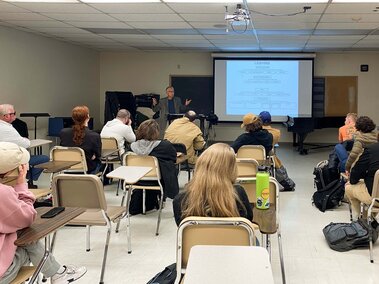
Donald Gorder discusses intellectual property at an entrepreneurship seminar in the Glenn Korff School of Music.