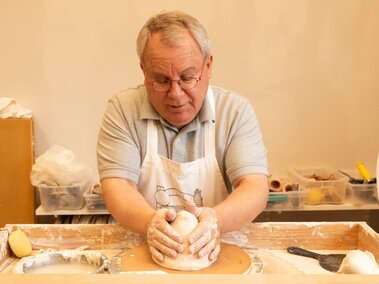
Pete Pinnell in his studio.
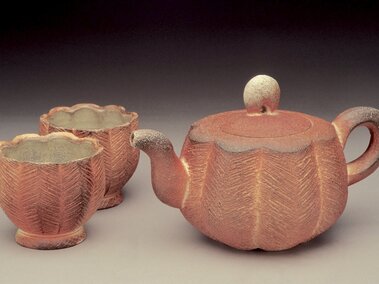
Soda-fired teapot and cups. Courtesy photo.
By L. Kent Wolgamott
Walk into any college or university ceramics studio, and you’re almost sure to find a bucket of “Pete’s Clear” and another of “Pete’s Cranberry Red.”
Those would be glazes created from recipes concocted by Pete Pinnell to replicate the flawless clear glaze found on Qing Dynasty ceramics and a Chinese bright copper red glaze.
“Part of what got me really interested early on was looking at these images of Chinese ceramics and these absolutely stunning glazes that have been made in the Song and Yuan and Ming dynasties and then to read ‘Well, this can't be made anymore.’ Part of me says, ‘Who says?’”
So Pinnell started researching the glazes, ordering books through interlibrary loan, getting chemical analyses of shards of the ancient vessels and studying how the glaze changed in relation to the distance from the clay body.
Then he set about finding the chemicals that could replicate the glaze and testing the mixture in the kiln.
“People give me all this credit for the recipe, but really it's what the Chinese made with contemporary American chemical materials,” said Pinnell, whose work with glazes and chemistry has been influential across the field of ceramics, from his writing in “Ceramics Monthly,” “Studio Potter,” “Clay Times” and “Ceramics Art & Perception” and from the widely used glaze recipes.
Following the clear glaze, Pinnell took a couple years to figure out the recipe for the copper-red glaze, which rapidly became an industry standard.
“Within five years, every art fair was full of bright red pots using that recipe, which is something we do,” Pinnell said. “You invent the recipe, and then you just send it out into the world and see what happens with it.”
Creating ancient glazes using contemporary chemicals began early in the career of Pinnell, who discovered ceramics while studying music at Columbia College in Columbia, Missouri.
After earning his B.A. in music, he studied at New York State College of Ceramics at Alfred University, where he received a B.F.A. and earned his M.F.A. in art from the University of Colorado.
“I always joke, though, that when I did find ceramics, they [my music professors] were the ones who were most encouraging of my moving in that direction,” he joked.
So what was it about ceramics that pulled Pinnell out of music and has kept him enthralled for decades?
“Here's why I love it,” he said. “Number one, the clay is amazing, right? You can do anything with clay. You can make it look like anything. But especially, I had this reinforced for me as a graduate student, it’s interactive art. That's how I would designate pottery. Interactive art allows the artist and the viewer to communicate in all the same ways I would if I put something on the wall. Touch is a very powerful thing. Interaction is a very powerful thing, too.”
When he was in school in the early ‘70s, Pinnell’s beautifully crafted pots were out-of-fashion, criticized as being “too tight” in an era under the influence of Peter Voulkos, who brought abstract expressionist gestures to clay.
But Pinnell’s primary graduate school professor Betty Woodman had a very different reaction to his work at their first critique.
“She spent a long time looking at it, picking it up and considering, without saying anything. And she started to go, ‘You know, Pete,’ and I'm just waiting. And she goes, ‘You really need to tighten up your work.’
“What Betty saw was what my work was trying to be. And it wasn't about trying to match what was in vogue. It was about an internal vision, my voice as an artist. So that gave me permission in many ways.”
Pinnell’s second validation, so to speak, came in 1996 when the newly arrived University of Nebraska-Lincoln ceramics professor, was invited to go to Yixing, the pottery capital of China where the world’s first teapots were made during the Ming Dynasty (1368-1644).
“Basically all of the world's teapots are based on Yixing teapots,” he said. “So watching them work and realizing that by American standards, everyone had looked at and talked about my work as if I was way over at the edge of the spectrum. I learned my work was closer to the middle historically. It wasn’t at the tighter, more precise end, and it wasn’t at the loose gestural end either.”
What most of it was and remains is utilitarian—cups, bowls, plates intended to be used and not just sit on the shelf. And, of course, it includes teapots, for which Pinnell is best known.
“What's fun about the teapot is it's a tool, for one thing,” Pinnell said. “It's very human in another way. There's a reason why it's the one art form that has its own children's song. ‘I'm a little painting, square and flat.’ Nobody does that song.
“It’s this thing that everybody knows about. Compositionally, it’s inherently asymmetrical, balancing a spout and a handle. Looking at that history, it’s absolutely fascinating how people do that, and the many ways you do that, and how to make it pour well and not make the tea cold. There’s a million things we think about in terms of making good tea, but also in terms of expression.”
Pinnell spent the first 12 years of his career as a studio potter while teaching part time at the Kansas City Art Institute and Johnson County Community College in Overland Park, Kansas.
In 1995, he joined the faculty at the University of Nebraska-Lincoln and served as chair of the School of Art, Art History & Design from 2011 to 2016.
From 2008 to 2014, Pinnell held the honorary title of Hixson-Lied Professor of Ceramics in recognition of his exhibition record.
So, Pete, do you have any idea how many objects you’ve made in the last 40-some years, it has to be in the tens of thousands, doesn’t it?
“Thousands, for sure,” he said. “I don't know about tens of thousands, because I do spend a lot of time on each object, way more than I think most potters do. There is a before and after for my career, The before was when I was a full-time potter. There I had to limit how much time I could spend per piece, because you had to make enough to make a house payment.
“But once I got here, the pressure on a faculty member isn't to make more objects, it's to make better objects, more prestigious objects. That’s one of the beauties of this position. It does give me or has given me, the ability to focus more on giving each work what it really needs. If I make fewer of them, that’s fine.”
Some of Pinnell’s objects are in museum collections, including the Frederick R. Weisman Art Museum in Minneapolis and the Sheldon Museum of Art.
Others are in private collections, and more still are being used in homes across the country.
“I have the typical list of galleries and shows and all of that, but to me, the best honor that I've received—that's not really the word—the best reflection I've gotten is from the fact that I've been invited to go to other universities and colleges,” Pinnell said.
“I've been a visiting artist now at 30 different colleges and universities, and I've been invited to do workshops and present my work at hundreds, literally, of community art centers and ceramic centers. That, to me, probably speaks more to how my work is viewed in the world than a list of shows or anything like that.”
Pinnell didn’t stop making ceramics when he taught his last class and retired in May 2025. He’s hard at work in his Richards Hall studio, using Nebraska-sourced material, such as Endicott Brick clay from Fairbury.
“My one funny local material, but it’s really a good one, is wood ash from Lazlo’s in the Haymarket. Wood ashes are really interesting material and glazes. They (Lazlo’s) are very consistent in their sourcing of wood, so they give really good wood ash. They’re really nice, they just say, ‘Come on over. You can fill your bucket.’”
--L. Kent Wolgamott recently retired as art and entertainment reporter for the Lincoln Journal-Star.
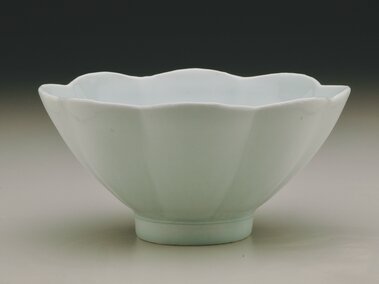
Fluted porcelain bowl. Courtesy photo.
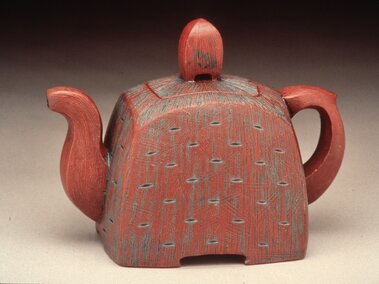
Red Earthenware teapot. Courtesy photo.
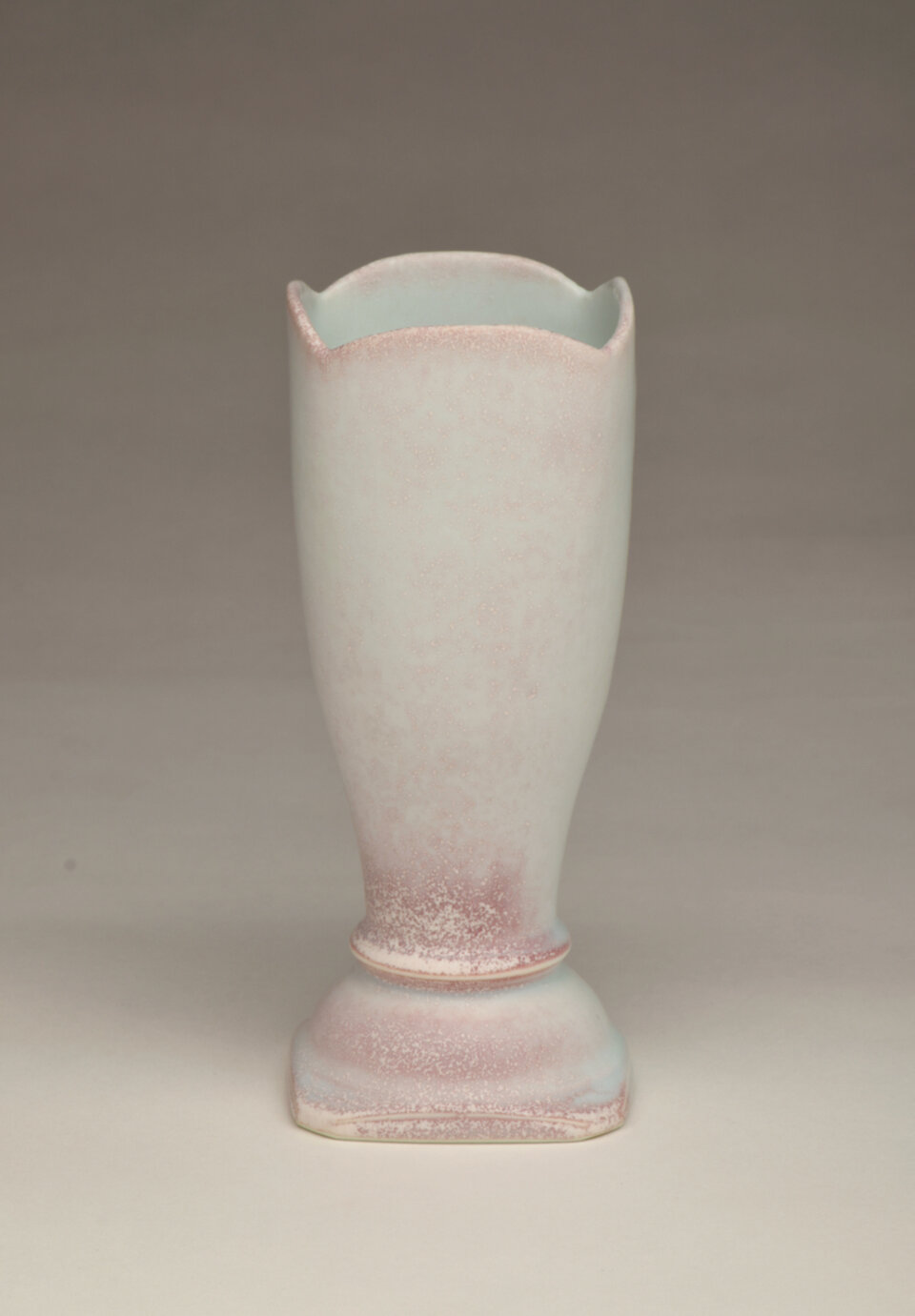
White/pink vase that Pinnell made at a residency at the Archie Bray Foundation in Montana. Courtesy photo.