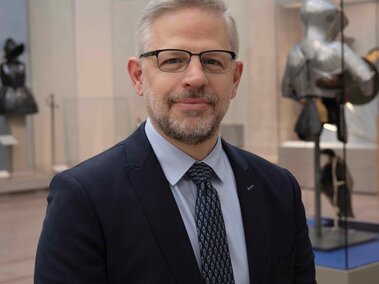
Ted Hunter at The Metropolitan Museum of Art. Courtesy photo.
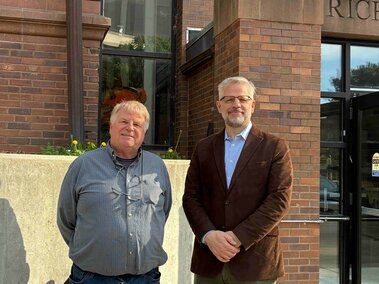
Ted Hunter (right) with Professor Michael Hoff outside Richards Hall. Photo by Kathe Andersen.
By Kathe C. Andersen
Edward “Ted” Hunter, the Armorer and Conservator of the Department of Arms and Armor at The Metropolitan Museum of Art in New York City, is the Alumni Achievement Award recipient in visual art.
“When I got the news, it was at a time when it’s probably the busiest I’ve ever been at the Metropolitan Museum with so many things going on and juggling a bunch of projects,” Hunter said. “And to have someone say they’ve noticed that work—you want your immediate boss to recognize it—but it’s nice to have the alma mater take a look at what you’ve been doing and think it had some value.”
Hunter enjoyed returning for the Honors Day weekend and meeting with students and faculty.
“Just actually having Dr. Hoff tell me to call him Michael is worth the price of admission right there,” Hunter said. “It is nice being back on campus. It feels pretty good. I don’t exactly feel 20 again, but you know, close enough.”
Hunter graduated in 1996 with a Bachelor of Arts degree in art history. He began as a studio art major before changing to art history.
“My father was a curator for the National Park Service for a long time, and so I certainly grew up in museums. As a kid, I enjoyed painting and drawing and always took a lot of art classes,” he said. “And, in fact, when I came to UNL my first semester I was a fine arts major, but that semester I took an art history class—I presume Art History 101—and I was captivated, to say the least. I’d been to museums. I knew what the Mona Lisa looked like. I had seen pictures of the Tower of Pisa and the Roman Forum and things like that. But it was another thing entirely to sit in the dark room with the slides and just look at that thing and to think about that thing and to sort of then try and piece together the story of history and art and culture and humanity and the way they all kind of link together as necessary components of studying art history.”
He had an internship at the Sheldon Museum of Art working for the preparator.
“Hanging art, matting and framing. I also had to water the plants—a bunch of jobs,” he said. “But being for the first time in a museum as a staff member rather than as a visitor and seeing behind the scenes—I touched a Warhol painting. Getting to experience all that was definitely a high point.”
He said he got a well-rounded education at Nebraska.
“I took classes in the English department, in the history department. I took photography courses and film studies, art history, fine arts, chemistry,” he said. “I came away very happy with my degree.”
Hunter said he had a number of professors who were there at the exact right moment, including Professor of Art History Michael Hoff.
“Dr. Hoff was there at exactly the right moment when I was just about to graduate,” he said. “I didn’t know what I was going to do next, and I went to his office and put the cards on the table. I said, ‘I like this, I liked this, I’m okay at this. I’m not great at that.’ And as he listened to my interests and areas of strengths and weaknesses, he suggested conservation, which given that my Dad worked in a museum, I’m shocked I really didn’t know anything about conservation.”
The more he looked into it, the more he liked what he saw.
“Dr. Hoff suggested the Institute of Archaeology, which turned out to be a perfect fit for me, and he was correct,” Hunter said. “I did two years there and got my Master of Science degree. Currently, I don’t really do anything in archaeology, but I think the tone and the academic culture at the institute were a good fit for me. The institute has a very strong ethical component to their education, which has served me very well in the field. In addition to being a great teacher, Dr. Hoff pointed me in the right place at the right time, and off I went.”
From 1997 to 1999, Hunter studied conservation at the Institute of Archaeology at University College London (UCL). While there, he interned at the Philadelphia Museum of Art, working with the Kienbusch Collection of arms and armor to assess and conserve the collection for the first time since its installation in 1977, and as a site conservator for a dig in Crete, Greece.
After graduating from UCL, he followed in his father’s footsteps to work as an Assistant Conservator for the National Park Service before joining the staff of the Metropolitan Museum of Art in New York in 2001.
A conservator’s primary role is to act in the interests of cultural heritage, and their duties can vary depending on the institution.
“In my case, I do directly treat the collection, arms and armor, and that might be something as simple as a little cleaning or a little wax, or it might be where we’re completely reconstructing some broken or missing element and everything in between,” Hunter said. “But I also worry about our environment and our gallery conditions. I work with the science department to make sure that the materials we use, either for treatment or storage or for display, are not contributing to the deterioration of the object. I also work with the museum administration and policy setting to make sure our policies and the way we do business are not harmful to the collection. But really, I think in the end, it’s all about preserving the cultural heritage and advocating for that collection.”
The arms and armor collection at The Met includes some 14,000 objects with about 1,000 on display at any time.
Hunter curated the “Defensive Display: Shields from The Met Collection” exhibition (go.unl.edu/metshields), now on display at The Met.
“It’s all objects drawn from our storage, things that, in many cases, haven’t been on display in 60 years or more,” Hunter said. ”It’s a mix of things, trying to show the commonalities of the basic tool of defense around the world and the way that they all bear certain similarities, even when they’re made out of different materials, but they are decorated in very different ways. I had never curated an exhibition before. It’s not something conservators typically do, but I had a shot, and I went for it.”
Every day is different for Hunter, but one of the favorite parts of his job is interacting with the collection.
“The best part of the job is being in the storeroom, looking at the artwork, working with it, pulling something out, examining it, taking it apart, whatever the case may be, and learning something new about it,” he said. “I also love interacting with the visitors. If I have to be in the galleries during the day for some reason, then I’ll walk through, and I like when people come and ask me questions. I like that people are there and they are looking at this stuff, and I want them to have a good time and go away with a good memory so that they’ll go to other museums, or they’ll come back to The Met. They will learn something or be inspired by what they are seeing.”
Hunter has been at The Met for nearly 25 years, and he still enjoys his work.
“I sometimes dread the commute, but I never dread going to work,” he said. “I’m happy I’m there even if individual days might be tough. I love going to work, and I love what I do.”
To view a video of Hunter describing how armor is mounted and displayed in the galleries at The Met, focused on a unique set of armor probably belonging to King Henry VIII of England, visit https://go.unl.edu/metarmor.
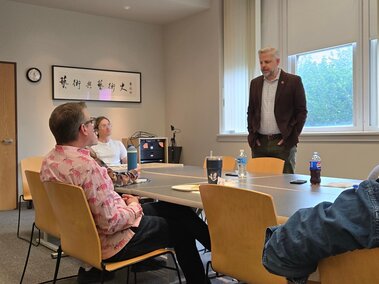
Ted Hunter visits with faculty and students during a lunch on May 2 in Richards Hall. Photo by Muskan Yadav.
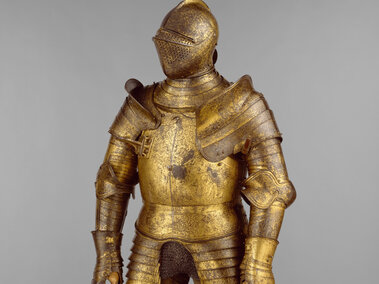
Armor Garniture, probably of King Henry VIII of England (reigned 1509-47), made in the Royal Workshops at Greenwich, dated 1527. From the exhibition “Defensive Display: Shields from The Met Collection. The Metropolitan Museum of Art, New York, William H. Riggs Gift and Rogers Fund, 1919. Courtesy photo.